

How to A/B Test Headlines That Actually Convert
Learn how to A/B test headlines with proven frameworks, 10 real examples, and step-by-step instructions to find headlines that drive measurable conversion lifts.

How to A/B Test Headlines That Actually Convert
Learning to A/B test headlines is the highest-leverage skill in conversion optimization. Your headline is the gatekeeper — it determines whether visitors read your page or hit the back button within seconds.
A/B testing headlines is the process of running controlled experiments where two or more headline variations are shown to equal, randomized segments of visitors to determine which version produces a statistically significant improvement in a target metric such as clicks, signups, or purchases.
Data consistently confirms what experienced marketers already know: headlines produce the largest conversion lifts of any single page element. Yet most teams write one headline and never touch it again. That is leaving money on the table every single day.
Why Headlines Are the Single Most Impactful Element to Test
The numbers are hard to argue with. Research from Copyblogger found that 80% of visitors read the headline but only 20% read the body copy. Your headline is not just important — for four out of five visitors, it is the only thing they read before deciding to stay or leave.
Advertising legend David Ogilvy went further: "On average, five times as many people read the headline as read the body copy. When you have written your headline, you have spent eighty cents out of your dollar."
Here is what the data shows across large-scale testing:
- Headlines are responsible for up to 50% of a page's overall conversion performance
- Headline tests produce winning variations at a higher rate than any other element
- A strong headline can lift conversions by 10-30% with a single test
- Keak's data across 2.1 billion+ impressions tested confirms that headline variations are the most consistently high-performing test type, contributing significantly to the platform's 73%+ test win rate
Compare that to button color tests that might move the needle by 2-3%. When you have limited testing bandwidth, headlines should always come first.
Headline Testing Frameworks
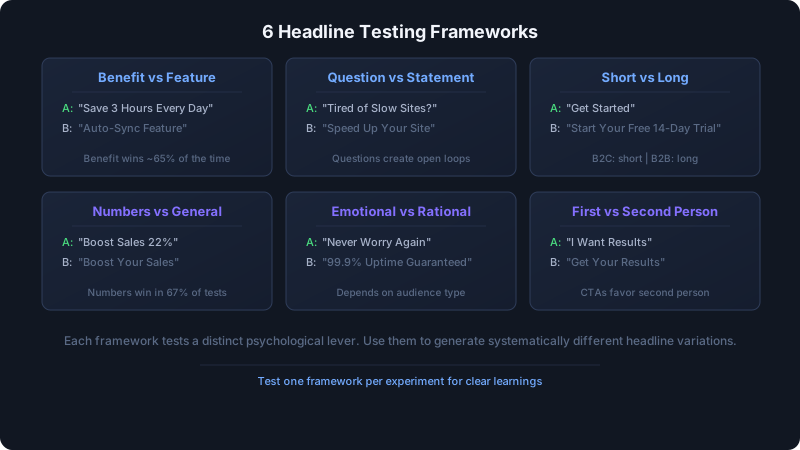
Do not guess at headline variations. Use proven frameworks to generate systematically different approaches. Each framework tests a distinct psychological lever.
Benefit-Driven vs. Feature-Driven
Benefit-driven headlines focus on the outcome the customer wants. Feature-driven headlines describe what the product does.
- Feature: "AI-Powered Email Automation Software"
- Benefit: "Send the Right Email to the Right Person — Automatically"
Benefit-driven headlines win roughly 60-70% of the time across industries. But feature-driven headlines can outperform when your audience is technically sophisticated and comparison-shopping.
Question vs. Statement
Questions engage the reader's brain differently than statements. They create an open loop that the visitor wants to close by reading further.
- Statement: "Your Landing Pages Are Losing 40% of Potential Customers"
- Question: "Are Your Landing Pages Losing 40% of Potential Customers?"
Questions work best when they articulate a pain the reader already feels. If the question describes a problem the reader does not recognize, it falls flat. Statements work better for audiences who already know the problem and want a solution.
Short vs. Long
Short headlines (under 8 words) rely on clarity and punch. Long headlines (12-20 words) provide context and specificity.
- Short: "Double Your Conversion Rate"
- Long: "How 1,200 E-Commerce Brands Doubled Their Conversion Rate in 30 Days"
There is no universal winner here. B2C audiences tend to respond to shorter headlines. B2B audiences, dealing with complex decisions and multiple stakeholders, often respond to longer, more specific headlines. Test both.
Specific Numbers vs. General Claims
Numbers add credibility and specificity. They turn vague promises into concrete expectations.
- General: "Grow Your Revenue with Better Landing Pages"
- Specific: "Grow Revenue 22.5% with AI-Optimized Landing Pages"
Headlines with numbers outperform those without in 67% of tests, according to analysis from Conductor. Odd numbers, surprisingly, outperform even numbers. And specific numbers ("22.5%") outperform round numbers ("20%").
Emotional vs. Rational
Emotional headlines tap into feelings — fear, excitement, frustration, aspiration. Rational headlines appeal to logic, data, and analysis.
- Emotional: "Stop Watching Competitors Steal Your Customers"
- Rational: "Reduce Customer Acquisition Cost by 34% with A/B Testing"
The winning approach depends on your audience and product category. High-consideration B2B purchases lean rational. Consumer products and services lean emotional. But test both — the results will sometimes surprise you.
First Person vs. Second Person
First-person headlines ("I," "my") put the reader in the driver's seat. Second-person headlines ("you," "your") speak directly to the reader.
- First person: "I Grew My Business 3x with One Simple Change"
- Second person: "Grow Your Business 3x with One Simple Change"
Both approaches test well. First person can feel more testimonial-like and authentic. Second person is more direct and action-oriented. CTA-adjacent headlines often perform better in second person, while story-driven pages benefit from first person.
10 Real Headline A/B Test Examples
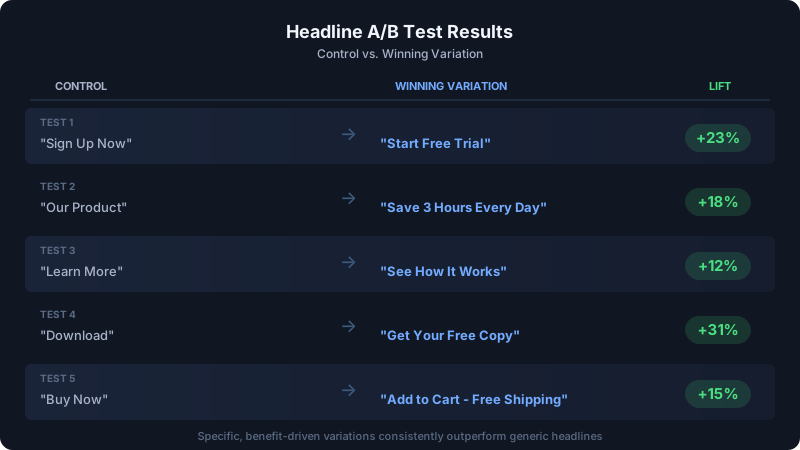
These examples illustrate the frameworks in action. Results are drawn from published case studies and common testing patterns observed across high-traffic pages.
Example 1: Specificity Wins
- Control: "Build Better Landing Pages"
- Variation: "Build Landing Pages That Convert 3x More Visitors"
- Result: +28% conversion rate
- Lesson: The specific outcome ("3x more visitors") gives the reader a concrete reason to care.
Example 2: Benefit Over Feature
- Control: "Advanced Analytics Dashboard"
- Variation: "See Exactly Where You're Losing Customers"
- Result: +19% click-through rate
- Lesson: The visitor cares about finding lost customers, not about dashboards.
Example 3: Question Reframe
- Control: "The Best CRM for Small Business"
- Variation: "Why Are 10,000 Small Businesses Switching to [Product]?"
- Result: +14% signups
- Lesson: The question creates curiosity and adds social proof simultaneously.
Example 4: Shorter Is Not Always Better
- Control: "Automate Your Marketing"
- Variation: "Automate Your Marketing and Get 10 Hours Back Every Week"
- Result: +22% conversion rate
- Lesson: The extra length added a specific, tangible benefit that the short version lacked.
Example 5: Emotional Trigger
- Control: "Project Management Software for Teams"
- Variation: "Stop Losing Projects to Missed Deadlines and Miscommunication"
- Result: +17% trial signups
- Lesson: The emotional version addressed the pain directly instead of describing the product.
Example 6: First Person Voice
- Control: "Reduce Your Tax Bill This Year"
- Variation: "How I Saved $12,000 on My Taxes Last Year"
- Result: +33% click-through rate
- Lesson: First person plus a specific dollar amount created a powerful, story-like headline.
Example 7: Number Placement
- Control: "Ways to Improve Your Website Conversion Rate"
- Variation: "7 Proven Ways to Improve Your Website Conversion Rate"
- Result: +11% engagement
- Lesson: Adding a number set clear expectations for the content and increased perceived value.
Example 8: Power Word Addition
- Control: "A Guide to Email Marketing"
- Variation: "The No-BS Guide to Email Marketing That Actually Works"
- Result: +21% page engagement
- Lesson: "No-BS" and "Actually Works" signal authenticity and differentiation in a crowded space.
Example 9: Social Proof in Headline
- Control: "Try Our Sales Platform Free"
- Variation: "Join 50,000+ Sales Teams Already Using [Product]"
- Result: +15% free trial signups
- Lesson: Social proof in the headline reduced the perceived risk of trying something new.
Example 10: Urgency Integration
- Control: "Start Your Free Trial Today"
- Variation: "Your Competitors Started Testing Last Week — Start Your Free Trial Now"
- Result: +12% trial starts
- Lesson: Competitive urgency motivated action without feeling like a fake countdown timer.
How to Generate Headline Variations
Great headline testing starts with generating genuinely different variations — not minor word swaps.
Start with customer research. Read your customer reviews, support tickets, and sales call transcripts. Pull out the exact language customers use to describe their problems and desired outcomes. Those phrases often make the best headlines.
Use the frameworks above as a brainstorming template. For every headline you write, create at least one variation using each framework: benefit vs. feature, question vs. statement, short vs. long, specific vs. general, emotional vs. rational.
Leverage AI to scale variation generation. Keak's V3 engine, trained on thousands of successful A/B tests, generates headline variations automatically and tests them against your existing headline. The AI learns from your specific audience's responses, so variations improve over time. This removes the creative bottleneck that slows down most testing programs.
Study your competitors' headlines. Not to copy them, but to identify what angles are already being used in your market — and what gaps exist. If every competitor leads with features, a benefit-driven headline will stand out.
Aim to generate 10-15 headline ideas per brainstorming session. Then narrow down to the 2-3 that represent the most distinctly different approaches for your first round of tests.
Step-by-Step: Running Your First Headline Test
Step 1: Define Your Success Metric
Before you write a single variation, decide what "winning" means. For landing pages, this is typically conversion rate — the percentage of visitors who complete your desired action (signup, purchase, demo request). Make sure your analytics tracks this metric reliably.
Step 2: Write Your Variations
Create 1-2 variations that are meaningfully different from your current headline. Do not test "Get Started Today" against "Get Started Now" — the difference is too small to produce actionable learnings. Use the frameworks above to create structurally different approaches.
Step 3: Set Up the Test
Use a testing tool that randomizes traffic evenly between variations. With Keak, this is as simple as installing the Chrome extension and letting Auto Pilot mode generate and launch the test — no tracking scripts, no code changes, and it works on Shopify, Webflow, WordPress, Framer, Squarespace, and any other website.
Step 4: Wait for Statistical Significance
Do not check results after day one and declare a winner. You need enough data for your results to be statistically reliable. This typically means at least 100 conversions per variation for a standard A/B test. Learn more about what statistical significance means and why it matters.
Step 5: Analyze and Implement
Once your test reaches significance, implement the winner and document what you learned. Then start your next test — the best testing programs are continuous, not one-off.
How Many Headlines to Test at Once
Test 2-3 variations at a time. Here is why:
- 2 variations (A/B test): Fastest to reach significance. Best when traffic is limited (under 5,000 visitors per week) or when you want clean, attributable results.
- 3 variations (A/B/C test): Good balance of exploration and speed. Requires roughly 50% more traffic than an A/B test to reach significance in the same timeframe.
- 4+ variations: Only viable with high-traffic pages (10,000+ visitors per week). More variations means more potential learnings per test cycle, but each individual comparison takes longer to reach significance.
If your page gets fewer than 2,000 weekly visitors, stick with simple A/B tests. You will reach significance faster and build a testing cadence that produces results.
When to Declare a Winner
Calling a test too early is the most common mistake in headline testing. Follow these rules:
- Statistical significance of 95% or higher. This means there is less than a 5% probability that the observed difference is due to random chance.
- Minimum sample size met. At least 100 conversions per variation for most tests.
- Full business cycle observed. Run the test for at least 7 days to account for day-of-week variations in visitor behavior. Ideally 14 days to capture two full weekly cycles.
- Results are consistent. If Variation B was winning for 10 days and then Variation A caught up on day 11, the test needs more time.
Keak's SPRT-based statistics engine handles this automatically. SPRT (Sequential Probability Ratio Test) is a method that continuously evaluates results and declares a winner as soon as there is sufficient evidence — no more guessing, no premature calls, no unnecessarily long tests.
Headlines by Page Type
Different page types have different headline jobs. Here is how to approach headline testing for each.
Homepage Headlines
Your homepage headline must communicate what you do and who you serve in under 5 seconds. Test clarity over cleverness. Homepage visitors are often in discovery mode, so the headline needs to answer "Am I in the right place?" immediately.
Test angles: Brand-forward vs. benefit-forward. Category descriptor vs. outcome statement.
Product Page Headlines
Product page headlines need to differentiate your specific product from alternatives. Visitors on product pages are comparing options, so specificity and unique value propositions perform well.
Test angles: Feature highlight vs. customer outcome. Technical specification vs. use case description.
Landing Page Headlines
Landing page headlines should match the intent of the traffic source that brought the visitor there. If they clicked a Google ad about "affordable CRM," your headline should include language about affordability and CRM. Message match between ads and landing page elements is critical.
Test angles: Pain-point vs. aspiration. Direct offer vs. educational hook.
Blog Post Headlines
Blog headlines compete in search results and social feeds. They need to earn the click in a crowded list of alternatives. Numbers, brackets, and power words perform disproportionately well in these contexts.
Test angles: Listicle format vs. how-to format. Curiosity gap vs. direct statement.
Build a Continuous Testing Habit
The teams that win at headline optimization are not the ones that run one test. They are the ones that test a new headline every 2-4 weeks, building a compound advantage that competitors cannot easily replicate.
Each test teaches you something about what your audience responds to. Over time, you develop an internal playbook — specific to your audience, your product, and your market — that no competitor can copy because it is built on your own data.
For a complete framework on how headline testing fits into your broader conversion rate optimization strategy, connect your headline learnings to tests across CTAs, layouts, and social proof elements.
FAQ
How long should I run a headline A/B test?
Run your test for a minimum of 7-14 days regardless of traffic volume, and continue until you reach 95% statistical significance with at least 100 conversions per variation. Higher-traffic pages may reach significance in a week. Lower-traffic pages may need 3-4 weeks. Never end a test early because one variation has a temporary lead.
What is a good conversion rate improvement from a headline test?
A 10-20% relative improvement from a single headline test is a strong result. Some tests produce 30-50% lifts, especially when the original headline was generic or misaligned with the target audience. Even a 5% improvement is worth capturing — those gains compound over multiple tests.
Should I test my headline before other page elements?
Yes. Headlines consistently produce the largest and most reliable conversion lifts of any single page element. Start with headlines, then move to CTA copy, above-the-fold layout, and social proof. Keak's data across 1.37 million+ variations confirms that headline changes are the most efficient starting point for optimization.
Can I test headlines on pages with low traffic?
You can, but it requires patience. With fewer than 500 weekly visitors, a single headline test may take 4-6 weeks to reach significance. Focus on testing dramatically different headlines (not minor wording tweaks) so that any real difference is large enough to detect with smaller samples. Also consider driving more traffic to the page before investing in optimization.
How do I know if my headline test results are statistically valid?
Look for 95% statistical significance — this means there is less than a 5% chance your results occurred by random chance. Most testing tools display confidence levels. Also check that you have collected enough total conversions (minimum 200 across all variations) and that the test ran for at least one full week to account for day-of-week effects.