

Conversion Rate Optimization: The Complete Guide for 2026
Master conversion rate optimization with this complete CRO guide. Learn the framework, tools, and advanced techniques to improve conversion rates in 2026.

Conversion Rate Optimization: The Complete Guide for 2026
Conversion rate optimization is the single most cost-effective growth lever most businesses ignore. While teams pour budget into driving more traffic, the businesses that win are the ones squeezing more revenue from the visitors they already have. This guide covers everything you need to know about CRO in 2026 -- from foundational frameworks to AI-powered testing strategies that are reshaping the field.
Conversion rate optimization (CRO) is the systematic process of increasing the percentage of website visitors who take a desired action -- whether that's making a purchase, filling out a form, or clicking a call-to-action -- by analyzing user behavior, forming hypotheses, and running controlled experiments to validate improvements.
If you've ever looked at your traffic numbers and thought "we should be getting more out of this," you're already thinking about CRO. Let's turn that instinct into a repeatable system.
What Is Conversion Rate Optimization?
Conversion rate optimization is the practice of improving your website's ability to turn visitors into customers, subscribers, or leads. It sits at the intersection of data analysis, user psychology, and experimentation.
Unlike traffic acquisition, which requires ongoing spend, CRO improvements compound over time. A headline change that lifts conversions by 15% keeps delivering that lift for every visitor who sees it -- tomorrow, next month, next year.
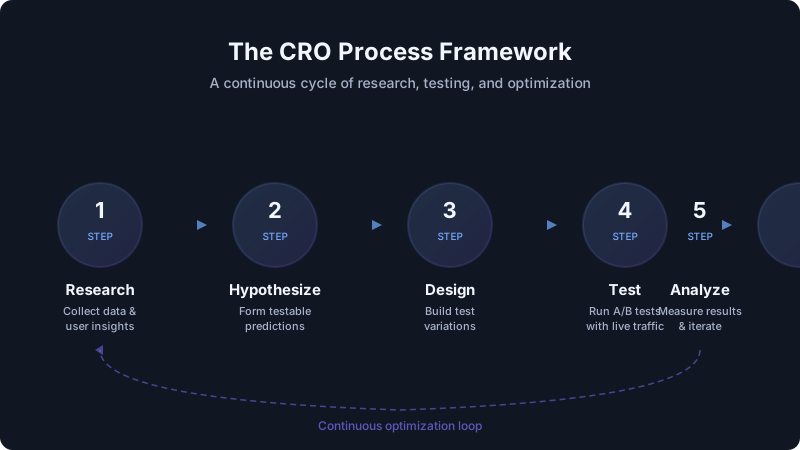
CRO is not guesswork. It's not redesigning your site based on what your CEO likes. It's a disciplined process of:
- Measuring what's happening on your site right now
- Identifying where visitors drop off or hesitate
- Hypothesizing what changes could improve outcomes
- Testing those changes with real traffic
- Implementing winners and starting again
The best CRO programs treat this as a continuous loop, not a one-time project. According to Forrester Research, companies that invest in CRO see an average ROI of 223%. That's because you're not spending more to get more -- you're getting more from what you already have.
How to Calculate Conversion Rate
Your conversion rate is the percentage of visitors who complete a desired action. The formula is straightforward:
Conversion Rate = (Number of Conversions / Total Visitors) x 100
Here's how it works in practice:
| Scenario | Visitors | Conversions | Conversion Rate |
|---|---|---|---|
| E-commerce store | 50,000 | 1,500 | 3.0% |
| SaaS landing page | 10,000 | 350 | 3.5% |
| Lead gen form | 25,000 | 1,250 | 5.0% |
| Newsletter signup | 100,000 | 8,000 | 8.0% |
A few important nuances:
Use the right denominator. If you're measuring checkout conversion, divide by the number of people who reached the checkout page -- not total site visitors. This gives you a more actionable metric.
Track micro and macro conversions. Macro conversions are your primary goals (purchases, signups). Micro conversions are smaller steps along the way (add to cart, email click, video play). Micro conversions tell you where the funnel is leaking.
Segment your data. Your overall conversion rate is a vanity metric. What matters is conversion rate by traffic source, device type, user segment, and page. A 3% overall rate might mask a 6% rate on desktop and a 1.2% rate on mobile -- which tells you exactly where to focus.
For a deeper look at what "good" looks like in your industry, check out our conversion rate benchmarks by industry.
The CRO Process: A Step-by-Step Framework
Effective conversion rate optimization follows a structured process. Skip steps and you end up running random tests that teach you nothing. Here's the framework used by the highest-performing CRO teams.
Step 1: Research and Data Collection
Before you change anything, understand what's happening now. This phase has two components:
Quantitative research tells you what is happening. Set up analytics to track:
- Page-level conversion rates
- Funnel drop-off points
- Bounce rates by landing page
- Exit pages
- Time on page and scroll depth
Qualitative research tells you why it's happening. Use:
- User session recordings
- Heatmaps (click, scroll, and attention maps)
- Customer surveys and exit-intent polls
- User interviews
- Customer support ticket analysis
The goal is to build a clear picture of where visitors struggle, hesitate, or leave. According to a 2024 Baymard Institute study, the average e-commerce cart abandonment rate is 70.19%. That's an enormous amount of lost revenue hiding in your funnel data.
Step 2: Hypothesis Formation
Turn your research findings into testable hypotheses. A strong hypothesis follows this format:
"Because we observed [data/insight], we believe that [change] will [outcome], which we will measure by [metric]."
Example: "Because we observed that 62% of mobile users abandon the checkout at the shipping form, we believe that reducing form fields from 8 to 4 will increase checkout completion rate, which we will measure by the percentage of users who reach the order confirmation page."
Prioritize ruthlessly. You can't test everything at once. Use a prioritization framework like ICE (Impact, Confidence, Ease) or PIE (Potential, Importance, Ease) to rank your hypotheses. Focus on high-impact, high-confidence tests first.
Step 3: Design and Build Variations
Create the test variations based on your hypotheses. Keep changes focused -- test one variable at a time unless you're running a multivariate test with enough traffic to support it.
This is where tools matter. Traditional A/B testing requires design and development resources for every variation. Platforms like Keak use AI to generate variations automatically -- headlines, CTAs, layouts, and images -- so you can launch tests without waiting on a dev sprint.
Step 4: Run the Test
Launch your A/B test and wait for statistical significance. This is where discipline matters most:
- Don't peek. Stopping a test early because one variation "looks like it's winning" leads to false positives. Use a statistics engine designed for sequential testing (like SPRT) to know when results are trustworthy.
- Run tests for at least one full business cycle (typically 1-2 weeks minimum) to account for day-of-week effects.
- Ensure adequate sample size. Use a sample size calculator before launching. Most tests need at least 1,000 conversions per variation to detect meaningful lifts.
Step 5: Analyze, Implement, and Iterate
When a test reaches significance:
- If the variation wins: Implement the change permanently and document the learnings.
- If the control wins: That's still a win -- you avoided making your site worse. Document why the hypothesis was wrong and use that insight to form better ones.
- If the result is inconclusive: The change likely doesn't matter much. Move on to higher-impact tests.
The best CRO programs run 15-30 tests per month. Volume matters because most tests don't produce massive lifts. Your overall improvement comes from compounding many small wins.
Key Elements to Optimize
Not all page elements are created equal. Here's where to focus your conversion rate optimization efforts, ranked by typical impact.
Headlines
Your headline is the first thing visitors read, and 80% of people never read past it (Copyblogger). A headline that clearly communicates your value proposition and matches the visitor's intent can lift conversions by 10-30%.
Test variations that:
- Lead with the primary benefit, not the feature
- Use specific numbers ("Save 3 hours per week" vs. "Save time")
- Match the language your customers actually use
- Create urgency without being manipulative
For a deep dive on this topic, see our guide on A/B testing headlines that convert.
Calls-to-Action (CTAs)
Your CTA is where intent becomes action. Small changes here produce outsized results.
Button copy matters more than button color. "Start My Free Trial" outperforms "Submit" because it communicates value and uses first-person language. According to Unbounce, personalized CTAs convert 202% better than generic ones.
Test: copy, placement, size, color contrast, surrounding whitespace, and the number of CTAs on the page.
Forms
Every additional form field is friction. Imagescape found that reducing form fields from 11 to 4 increased conversions by 120%. Only ask for what you absolutely need at this stage.
Other form optimizations:
- Use inline validation (show errors as users type, not after submission)
- Add progress indicators for multi-step forms
- Pre-fill fields when possible
- Place labels above fields, not beside them
Layout and Page Structure
How you organize information guides the visitor's eye and decision-making process. Key principles:
- Visual hierarchy: Make the most important elements (headline, CTA, key benefit) the most visually prominent.
- F-pattern and Z-pattern: Design for how people actually scan web pages.
- White space: Crowded pages feel overwhelming. Give elements room to breathe.
- Above the fold: Your value proposition and primary CTA should be visible without scrolling.
Images and Media
Product images directly impact purchase decisions. For e-commerce, high-quality images can increase conversions by up to 40% (MDG Advertising). But the wrong hero image on a landing page can distract from your message.
Test: product photos vs. lifestyle images, with-people vs. without, image size, and video vs. static images.
Social Proof
Humans are social animals. We look to others when making decisions. 92% of consumers read online reviews before purchasing (BrightLocal).
Types of social proof to test:
- Customer testimonials (with photos and specific results)
- Star ratings and review counts
- Trust badges and security seals
- Client logos
- "X customers served" counters
- Case studies with measurable outcomes
CRO Tools and Technologies
The right tools make CRO faster and more effective. Here's how the major platforms compare in 2026:
| Tool | Type | AI-Powered | No-Code | Starting Price | Best For |
|---|---|---|---|---|---|
| Keak | AI A/B testing | Yes (V3 engine) | Yes (Chrome Extension) | Free (10K impressions) | Automated testing at scale |
| VWO | Traditional A/B testing | Limited | Yes | $357/mo | Enterprise testing programs |
| Optimizely | Experimentation platform | Limited | No | Custom pricing | Large engineering teams |
| AB Tasty | A/B testing + personalization | Partial | Yes | Custom pricing | Mid-market personalization |
| Convert.com | Privacy-focused A/B testing | No | Yes | $399/mo | Privacy-conscious teams |
The major shift in 2026 is the move toward AI-powered testing. Traditional platforms require you to come up with hypotheses, design variations, and manage the entire testing workflow manually. That's why most companies run fewer than 5 tests per month -- the bottleneck isn't traffic, it's human bandwidth.
Keak takes a fundamentally different approach. Its AI agent generates variations, launches tests, waits for statistical significance using its SPRT-based engine, learns from results, and repeats -- all on Auto Pilot. The result: a 73%+ test win rate and an average 22.5% conversion rate increase within 2 weeks. Because the platform operates via a lightweight browser extension (~34KB gzipped), there are no tracking scripts to install and no code changes required.
For more on how AI is transforming experimentation, read our guide on how AI is changing CRO.
Common CRO Mistakes to Avoid
After analyzing thousands of testing programs, these are the mistakes that sink CRO efforts most often.
1. Testing Without a Hypothesis
Running random tests -- "let's try a green button" -- wastes time and teaches you nothing. Every test should be grounded in data and tied to a clear hypothesis. Without a hypothesis, you can't learn from the result regardless of whether it wins or loses.
2. Stopping Tests Too Early
This is the most common statistical error in CRO. A test that shows a 30% lift after 2 days with 200 visitors is not a winner. It's noise. Wait for your statistics engine to declare significance. If you're using frequentist methods, aim for 95% confidence. If you're using sequential testing (like SPRT), the engine will tell you when to stop.
3. Ignoring Mobile
In 2025, mobile accounted for 60.67% of global web traffic (Statcounter). Yet many CRO programs test exclusively on desktop. Always segment results by device. A change that lifts desktop conversions might tank mobile performance.
4. Optimizing for the Wrong Metric
A landing page test that increases click-through rate by 50% but decreases downstream purchases is a net loss. Optimize for revenue-impacting metrics, not vanity metrics. Track the full funnel.
5. Making Too Many Changes at Once
If you change the headline, hero image, CTA, and form in a single test, you won't know which change drove the result. This makes it impossible to build cumulative knowledge. Test one element at a time, or use multivariate testing with sufficient traffic.
6. Copying Competitors
What works for another company's audience, traffic mix, and product won't necessarily work for yours. Use competitor analysis for inspiration, not imitation. Your CRO program should be driven by your data, not someone else's.
How to Build a CRO Culture in Your Organization
The highest-performing CRO programs aren't run by a single person -- they're embedded in the company's culture. Here's how to get there.
Get Executive Buy-In with Revenue Data
Don't pitch CRO as "website testing." Pitch it as revenue growth. Calculate the revenue impact of a 1% conversion rate improvement and present that number. If your site generates $5M annually at a 2% conversion rate, a 1% absolute improvement (to 3%) represents $2.5M in additional revenue -- with zero additional ad spend.
Establish a Testing Cadence
Set a target for tests per month and track it. Start with 4-8 tests per month and scale up. Automation tools can dramatically accelerate this -- Keak's Auto Pilot mode runs continuous tests without manual intervention, which is particularly valuable for teams without dedicated CRO resources.
Create a Learning Repository
Document every test: hypothesis, variation, result, and insight. Over time, this becomes your organization's most valuable CRO asset. It prevents you from re-running failed tests and helps new team members understand what you've already learned.
Democratize Testing
The best ideas don't always come from the marketing team. Customer support reps hear objections daily. Sales teams know what questions prospects ask. Product managers see feature usage data. Create a system where anyone can submit a test idea, then prioritize them through your ICE or PIE framework.
Measure the Program, Not Just Individual Tests
Track your CRO program's aggregate impact: cumulative revenue lift, test velocity, win rate, and average lift per winning test. This keeps the program accountable and justifies ongoing investment.
Advanced CRO Techniques
Once you've mastered the fundamentals, these advanced techniques can unlock the next level of conversion performance.
Personalization
Not all visitors want the same thing. Personalized experiences convert 2-5x better than generic ones. Segment visitors by:
- Traffic source (paid vs. organic vs. referral)
- Geographic location
- Device type
- New vs. returning visitor
- Browsing behavior and intent signals
Then serve tailored headlines, offers, and content to each segment. The key is starting simple -- personalize by one dimension at a time and measure the incremental lift.
AI-Powered Testing
Traditional A/B testing is limited by human creativity and bandwidth. AI-powered testing removes both constraints.
Modern AI testing platforms can:
- Generate dozens of variations based on patterns from successful tests
- Allocate traffic dynamically to the best-performing variations
- Learn continuously from results to improve future suggestions
- Run 24/7 without human oversight
This is the direction the industry is heading. Teams using AI-powered optimization are running 10-50x more tests than those relying on manual processes. The compounding effect of that test velocity is enormous.
For a detailed look at AI-driven experimentation, see our A/B testing landing page elements guide.
Sequential Testing and Bayesian Methods
Traditional frequentist A/B testing requires you to set a sample size upfront and wait until the test is complete to read results. Sequential testing methods like SPRT allow you to monitor results continuously and stop as soon as significance is reached, without inflating your false positive rate.
This can cut test duration by 30-50%, which means faster iteration and more tests per month.
Full-Funnel Optimization
Most CRO programs focus on landing pages. But the biggest gains often come from optimizing the entire funnel:
- Top of funnel: Ad-to-landing-page message match
- Mid-funnel: Product pages, category pages, content engagement
- Bottom of funnel: Cart, checkout, pricing pages
- Post-conversion: Onboarding, upsells, retention flows
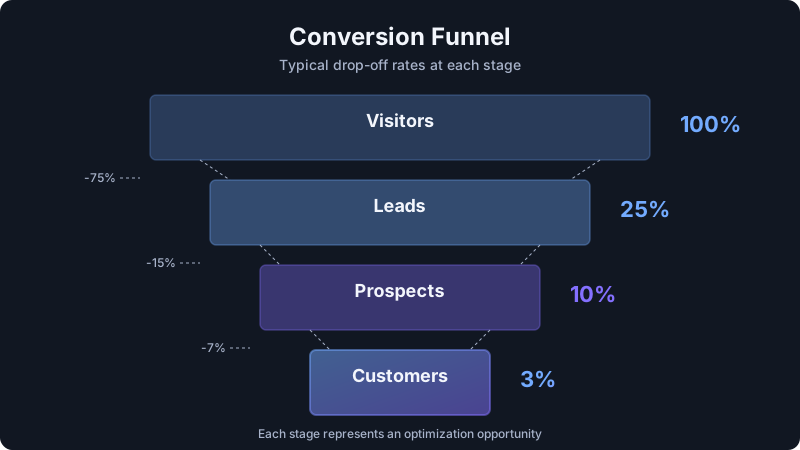
Map your funnel, identify the biggest drop-off points, and prioritize tests where the volume and impact are highest.
Multivariate Testing
When you have enough traffic (typically 100K+ monthly visitors per tested page), multivariate testing lets you test multiple elements simultaneously and identify the best combination of changes. This is more efficient than sequential A/B tests but requires significantly more traffic to reach significance.
Getting Started: Your First 30 Days
If you're launching a CRO program from scratch, here's your roadmap:
Week 1: Set up analytics and tracking. Ensure you're accurately measuring conversion events across your key pages. Audit your current conversion rates by page, device, and traffic source.
Week 2: Conduct qualitative research. Review session recordings, set up heatmaps, and run a quick customer survey. Identify your top 3-5 friction points.
Week 3: Form hypotheses and prioritize. Create your testing backlog, score each hypothesis with ICE, and design your first 2-3 test variations.
Week 4: Launch tests and establish your cadence. Run your first tests, set up a results dashboard, and schedule weekly CRO reviews with your team.
From there, it's about building momentum. Increase test velocity, expand to more pages, and continuously refine your hypotheses based on what you learn.
FAQ
What is a good conversion rate?
A "good" conversion rate depends entirely on your industry, business model, and what you're measuring. Average e-commerce conversion rates sit between 2-4%, while SaaS free trial signups often range from 3-8%. The more important question is whether your conversion rate is improving over time. Focus on beating your own baseline rather than chasing an industry average. Check our conversion rate benchmarks by industry for detailed data.
How long should I run an A/B test?
Run your test until it reaches statistical significance -- typically a minimum of 1-2 weeks to account for day-of-week variation. The exact duration depends on your traffic volume and the size of the effect you're trying to detect. Never stop a test early because one variation "looks" better. Use a statistics engine that tells you when results are reliable. Sequential testing methods like SPRT can shorten test duration without sacrificing accuracy.
Do I need a lot of traffic for CRO?
You need enough traffic to reach statistical significance within a reasonable timeframe. For most A/B tests, that means at least 1,000 conversions per variation. If your site gets fewer than 10,000 monthly visitors, focus on larger changes (full page redesigns, offer changes) rather than micro-optimizations (button color, font size). You can also test higher-funnel metrics like click-through rate, which require less traffic than purchase conversions.
What's the difference between A/B testing and CRO?
A/B testing is one technique within CRO. CRO is the entire discipline -- it includes research, hypothesis formation, A/B testing, user experience analysis, personalization, and continuous optimization. Think of A/B testing as the scientific method's experiment phase, while CRO is the full scientific method applied to your website's performance.
Can I do CRO without a developer?
Yes. Modern no-code tools make it possible to run a full CRO program without writing a single line of code. Platforms like Keak work entirely through a Chrome browser extension -- no tracking scripts, no code changes, and no developer dependencies. You can test headline variations, CTA copy, images, and layouts on any website platform including Shopify, Webflow, WordPress, and Squarespace. That said, some advanced tests (like checkout flow changes) may still benefit from developer support.