

How AI Is Changing Conversion Rate Optimization
AI conversion optimization is transforming how teams improve websites. Learn 5 ways AI is reshaping CRO and what autonomous optimization means for your business.

How AI Is Changing Conversion Rate Optimization
AI conversion optimization is not a future trend. It is happening now, and it is fundamentally changing how websites are improved. The old model -- hire a CRO specialist, run a few tests per month, debate results in a meeting -- is being replaced by AI systems that generate, test, and implement optimizations autonomously.
This is the biggest shift in conversion rate optimization since A/B testing tools first became widely available in the early 2010s.
AI conversion optimization is the use of artificial intelligence -- including machine learning, generative AI, and autonomous agents -- to identify, create, test, and implement website changes that increase conversion rates, reducing or eliminating the need for manual human intervention at each stage of the optimization process.
If you run a website that depends on conversions -- and almost every website does -- understanding this shift is not optional. Here is what is changing, why it matters, and what it means for your team.
The Shift from Manual to AI-Driven CRO
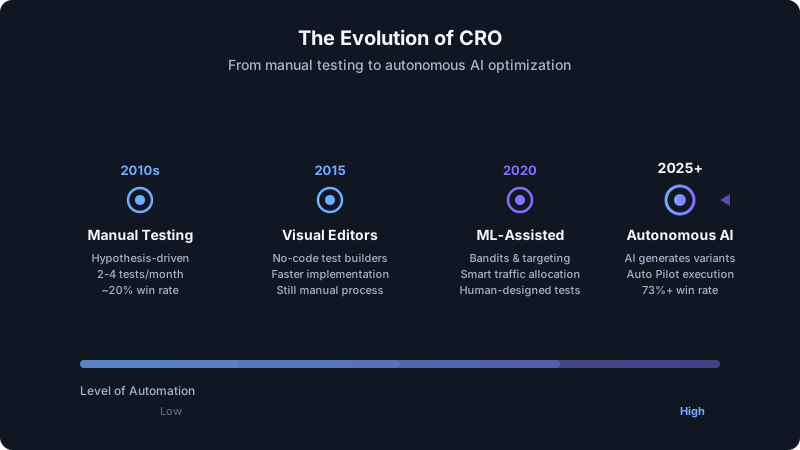
Traditional CRO is a labor-intensive discipline. A typical optimization cycle looks like this: analyze data to find opportunities, form a hypothesis, design a variant, get developer resources to implement it, configure the test, run it for 2-6 weeks, analyze the results, and then start over. Each cycle requires multiple roles and significant coordination.
Most teams manage 2-4 tests per month with this approach. And the win rate for manual A/B tests sits between 10-30%, according to CXL Institute research. That means the majority of the time and money spent on CRO produces no measurable improvement.
AI changes the equation in three fundamental ways:
- Speed. AI generates variations in seconds, not days. There is no design review, no developer queue, no back-and-forth on copy.
- Volume. Instead of 2-4 tests per month, AI systems run dozens. More tests mean more data, more winners, and faster learning.
- Intelligence. Each test result feeds back into the AI model. The system gets smarter over time, increasing its win rate with every experiment.
The result is not a marginal improvement over manual CRO. It is a structural advantage that compounds over time. Platforms like Keak demonstrate this with a 73%+ test win rate -- compare that to the 10-30% industry average for manual tests.
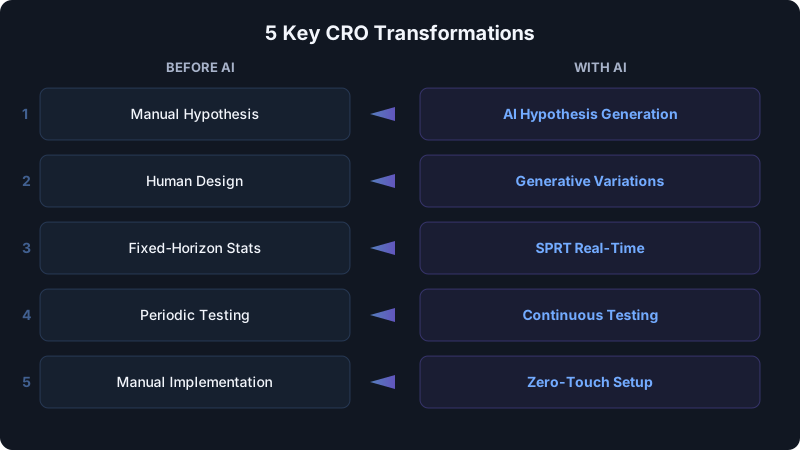
5 Ways AI Is Transforming CRO
1. Automated Hypothesis Generation
In traditional CRO, generating good hypotheses is a bottleneck. It requires experience, data analysis skills, and creative thinking. A seasoned CRO specialist might generate 10-20 test ideas per month after reviewing heatmaps, session recordings, and analytics data.
AI eliminates this bottleneck entirely. Machine learning models trained on thousands of successful tests can identify what to test on a given page in seconds. They analyze page structure, copy, visual hierarchy, CTA placement, and dozens of other factors to prioritize tests by expected impact.
This is not guesswork. Keak's V3 engine is an ML model built on data from over 2.1 billion impressions and 1.37 million variations. It has seen what works across thousands of different websites, industries, and audience types. That training data produces hypotheses that are systematically better than human intuition.
Example: A human CRO analyst might hypothesize that changing a CTA button from "Submit" to "Get Started" will improve conversions based on best-practice guidance. The AI might suggest that specific change plus three other copy variations it has seen succeed in similar contexts, and rank them by predicted lift. The human runs one test. The AI runs four -- and the four are better targeted.
2. Generative Variation Creation
This is where the impact of large language models and generative AI becomes tangible. Traditional A/B testing requires someone to write alternative headlines, craft new CTA copy, and sometimes redesign page sections. That means involving copywriters, designers, and developers.
AI generates variations instantly. Alternative headlines, rewritten value propositions, new button text, restructured layouts -- all created by the AI based on what it has learned drives conversions. The quality of these AI-generated variations has improved dramatically. They are not template-based fill-in-the-blank outputs. They are contextually relevant, persuasion-aware, and tailored to your specific page.
The numbers tell the story. Across the Keak platform, AI has generated over 1.37 million variations to date. That volume of creative output would require a large team working full-time. With AI, it happens automatically.
For a detailed walkthrough of how this process works, see our complete guide to AI A/B testing.
3. Smarter Statistical Analysis
Most A/B testing tools still use fixed-horizon frequentist statistics. You decide on a sample size before the test starts, run until you hit that number, and then check your p-value. The problem is well-documented: people peek at results early, stop tests when they see promising numbers, and end up with false positives. According to Evan Miller's research, peeking at results can inflate false positive rates from the target 5% to over 25%.
AI-driven CRO platforms use more sophisticated statistical methods. Sequential Probability Ratio Test (SPRT) is one approach that is specifically designed for continuous monitoring. Unlike fixed-horizon tests, SPRT lets you check results at any point without inflating your error rate. It also tends to reach conclusions faster, because it can declare a winner (or a loser) as soon as sufficient evidence accumulates -- it does not need to wait for a predetermined sample size.
This matters for two reasons. First, you get trustworthy results faster. Second, you waste less traffic on tests that have already reached a clear conclusion. Both translate directly to better optimization outcomes.
4. Autonomous Test Execution
The most transformative change is the move toward fully autonomous optimization. In this model, the AI does not wait for a human to review results, select the next test, and configure the experiment. It handles the entire loop: generate variations, launch the test, analyze results, implement the winner, generate new variations informed by the outcome, and repeat.
Keak's Auto Pilot mode is an example of this approach. Once activated, the AI agent continuously optimizes your site without requiring any manual intervention. It generates website variations -- headlines, CTAs, images, layouts -- launches A/B tests automatically, waits for statistical significance, learns from results, and repeats the cycle.
The average outcome across Auto Pilot users is a 22.5% conversion rate increase within 2 weeks. And because the system is always running, those improvements compound over time rather than stalling between manual test cycles.
For teams that want more control, the same AI capabilities can be used in a supervised mode where you review and approve each test before it goes live. The flexibility is key -- not every team is ready to hand over full control, and that is fine.
5. Zero-Friction Implementation
Traditional CRO tools require significant technical setup. You need to install tracking scripts, configure tag managers, sometimes modify your site's codebase, and coordinate with developers to implement winning variations. This friction slows down optimization programs and creates dependencies on engineering teams.
AI-native CRO tools have eliminated most of this friction. Keak operates through a Chrome browser extension -- no tracking scripts, no code changes, no developer involvement. The platform works on Shopify, Webflow, WordPress, Framer, Squarespace, and any other website. The pixel is approximately 34KB gzipped, loads asynchronously, and adds roughly 10ms to page load time.
For developer-led teams, a Code SDK provides deeper integration without sacrificing the AI automation layer. But the point is that the technical barrier to running an optimization program has dropped to near zero. This democratizes CRO in a way that was not possible with legacy tools.
What Autonomous CRO Means for Marketing Teams
The shift to AI-driven CRO does not eliminate the need for marketing teams. It changes what those teams spend their time on.
Before AI CRO, a typical optimization team spent 80% of their time on execution: writing test briefs, creating variants, configuring tools, monitoring tests, and compiling reports. Only 20% of their time went to strategic work -- understanding customers, identifying new opportunities, and aligning optimization with business goals.
With AI CRO, that ratio inverts. The AI handles execution. Your team focuses on strategy, customer research, and cross-functional alignment. Instead of debating whether a green or blue button will convert better, your team is thinking about which customer segments are underserved, which value propositions resonate with different audiences, and how optimization fits into the broader growth strategy.
This is a better use of human talent. Machines are better at generating and testing variations at scale. Humans are better at understanding context, setting priorities, and making strategic decisions. AI CRO puts each in their zone of strength.
The cost implications are significant too. Building a traditional CRO team -- analyst, designer, developer, strategist -- costs $150,000-$400,000 per year. An automated website optimization tool costs a fraction of that. Keak's plans range from a free tier (5,000 monthly impressions) to Pro at $150/month for 50,000 impressions. Even enterprise-scale testing costs less than a single full-time CRO analyst.
The Data Advantage: Why AI Outperforms Human Intuition at Scale
Human intuition is valuable but limited. A CRO specialist might have experience from 100-500 A/B tests across their career. That is a solid foundation, but it is fundamentally constrained by individual memory, the range of industries they have worked in, and the natural biases that affect all human decision-making.
An AI model operates on a different scale entirely. Keak's V3 engine has been trained on thousands of successful A/B tests across a wide range of industries, page types, and audience segments. It has processed 2.1 billion+ impressions and served 1.4 million+ weekly users. That data advantage produces measurably better outcomes.
Consider the HiPPO problem -- the tendency for the Highest Paid Person's Opinion to override data in decision-making. According to a Baymard Institute study, 69.82% of online shopping carts are abandoned, yet many teams prioritize testing homepage elements over checkout flow improvements because leadership finds homepage redesigns more exciting. AI does not have this bias. It tests what the data says will have the highest impact, regardless of internal politics.
The compounding effect is the real story. Each test result improves the AI model's predictions for the next test. After 10 tests, the AI's accuracy is measurably higher than after the first test. After 100 tests, the gap between AI performance and human-only performance has widened significantly. This is not a one-time advantage. It is an accelerating one.
What's Coming Next: Predictive Optimization
The current generation of AI CRO tools is reactive -- they test changes and measure results. The next generation will be predictive. Instead of running an experiment to find out whether a variation is better, the AI will predict the outcome with high confidence before any traffic is allocated.
Three capabilities are converging to make this possible:
Larger training datasets. As AI testing platforms accumulate more results, their predictive models become more accurate. The jump from thousands to millions of test results will enable predictions that are reliable enough to act on without testing.
Better user segmentation. AI will not just predict the best page for your average visitor. It will predict the best page for each visitor segment -- new vs. returning, mobile vs. desktop, high-intent vs. browsing. This merges A/B testing with personalization.
Real-time adaptation. Pages will change dynamically based on user behavior signals detected in real time. The line between "testing" and "serving" will blur. Your website will continuously adjust itself to maximize conversion for each individual visitor.
This future is not science fiction. The building blocks exist today. Teams that adopt AI CRO now will have a significant head start when predictive optimization becomes mainstream, because their AI models will already have months or years of learning to draw from.
For a detailed look at conversion rate optimization fundamentals and how they are evolving, see our CRO guide.
FAQ
Does AI CRO replace my marketing team?
No. AI CRO replaces the repetitive execution work your team currently spends most of their time on -- creating variations, configuring tests, monitoring experiments, and compiling results. Your team shifts to higher-value strategic work: customer research, competitive analysis, brand positioning, and cross-functional alignment. Most teams find that AI CRO makes their existing people more effective, not redundant.
How much traffic do I need for AI-powered CRO to work?
You need less than you think. Traditional fixed-horizon A/B tests require large sample sizes, but AI platforms using methods like SPRT (Sequential Probability Ratio Test) reach valid conclusions with smaller samples. If your site receives 10,000+ monthly visitors, you can run meaningful AI-driven tests. Keak offers a free plan at this traffic level so you can validate the approach before committing budget.
Is AI CRO only for e-commerce sites?
Not at all. AI conversion optimization works for any website with a measurable conversion action: SaaS signups, lead generation forms, content subscriptions, app downloads, booking flows, and more. The AI optimizes whatever conversion metric you define. E-commerce sites tend to adopt CRO tools early because the ROI is directly measurable in revenue, but the methodology applies to any conversion funnel.
How do I know the AI's changes won't hurt my brand?
Every change the AI makes is tested against your current page in a controlled experiment. A variation only "wins" if it statistically outperforms your original. If a variation performs worse, it is automatically discarded -- your visitors never see a permanent change that hurts conversions. You can also set guardrails around what the AI can and cannot modify, and review variations before they go live if you prefer a supervised approach.
See how AI is transforming CRO for real websites. Try Keak free -- connect your site in 60 seconds, no code required.