

AI A/B Testing: How It Works and Why It's Better
Learn how AI A/B testing automates experiment creation, analysis, and optimization. Discover why teams using AI testing see 22.5% higher conversion rates.

AI A/B Testing: How It Works and Why It's Better
AI A/B testing is replacing the slow, manual experimentation process that has bottlenecked growth teams for over a decade. Instead of spending hours writing hypotheses, designing variants, and waiting weeks for results, an AI agent handles the entire testing lifecycle -- from generating variations to declaring winners and applying changes.
This guide covers everything you need to know: how AI-powered A/B testing works under the hood, why it consistently outperforms manual methods, and how to start running autonomous tests on your site today.
AI A/B testing is a method of website optimization where artificial intelligence autonomously generates page variations, runs controlled experiments against live traffic, evaluates results using statistical models, and iterates -- continuously improving conversion rates without requiring manual intervention at each step.
If you have been running A/B tests manually (or worse, not running them at all), this is the shift that changes the math on what is possible for your conversion funnel.
What Is AI A/B Testing?
AI A/B testing is the application of machine learning and generative AI to every stage of the A/B testing process. Traditional A/B testing requires a human at every step: someone has to identify what to test, create the variants, set up the experiment, monitor traffic allocation, wait for statistical significance, and then decide what to do with the results. AI A/B testing compresses or eliminates most of those steps.
At its core, the concept is simple. An AI system analyzes your website, generates alternative versions of specific elements -- headlines, calls to action, images, layouts -- and then runs a statistically rigorous experiment to determine which version performs better. The difference is that the AI does not stop after one test. It learns from the outcome, generates new hypotheses, and keeps testing.
The result is a continuous optimization loop that would require an entire team of analysts, designers, and developers to replicate manually.
According to HubSpot's State of Marketing Report, only 17% of marketers use A/B testing to improve conversions. The primary reason is not a lack of desire -- it is the time and expertise required. AI removes both barriers.
How AI A/B Testing Differs from Traditional A/B Testing
Traditional A/B testing is a linear process. You form a hypothesis, build a variant, run the test, analyze results, and then start over. Each cycle takes 2-6 weeks depending on traffic volume and the size of the effect you are trying to detect.
AI A/B testing is a parallel, continuous process. Multiple elements can be tested simultaneously. Variants are generated in seconds rather than days. Statistical analysis happens in real time. And the system does not wait for you to start the next experiment -- it is already running.
This is why platforms like Keak report a 73%+ test win rate across their user base. The AI has been trained on thousands of successful experiments and applies those patterns to generate higher-quality variations from the start.
How AI A/B Testing Works (Step by Step)
Understanding the mechanics helps you evaluate tools and set realistic expectations. Here is how a modern AI A/B testing system operates, from setup to results.
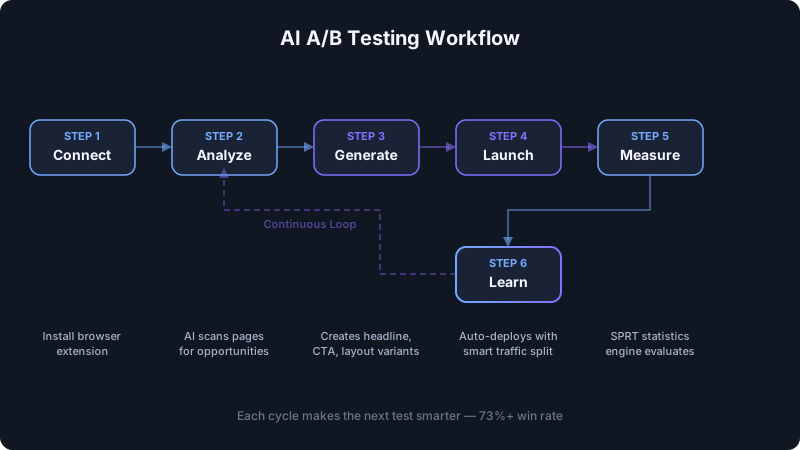
Step 1: Connect Your Website
The best AI testing tools require zero code changes to get started. Keak, for example, works through a lightweight browser extension for Chrome. There is no tracking script to install, no developer sprint to schedule, and no tag manager configuration. You point the tool at your site, and it is ready.
For teams that want deeper integration, a code SDK is also available. But the key point is that the barrier to entry is near zero.
Step 2: AI Analyzes Your Pages
The AI scans your website and identifies testable elements: headlines, subheadlines, hero images, CTA button text, CTA button colors, form layouts, social proof placement, navigation structure, and more. It does not test randomly. The AI prioritizes elements with the highest expected impact on conversions based on patterns learned from prior experiments.
This is where training data matters. Keak's V3 engine is a machine learning model trained on thousands of successful A/B tests, which means it starts with strong priors about what kinds of changes tend to move the needle for different types of pages and industries.
Step 3: AI Generates Variations
Here is where generative AI enters the picture. The system creates alternative versions of the elements it has selected for testing. A headline might get three new variations. A CTA button might get tested with different copy, different colors, or a different position on the page.
These are not random permutations. The AI generates variations informed by conversion optimization principles -- urgency, clarity, specificity, social proof, benefit-driven language -- and by what has worked in similar contexts across its training data.
To date, AI testing platforms have created over 1.37 million variations across their user bases. That volume of experimentation is simply not achievable with manual processes.
Step 4: Traffic Allocation and Experiment Launch
The experiment goes live automatically. Traffic is split between the original page (control) and the variations. Modern AI testing tools use intelligent traffic allocation, sending more traffic to higher-performing variants over time rather than maintaining a rigid 50/50 split throughout the experiment.
Keak's pixel is approximately 34KB gzipped, loads asynchronously, and renders within 10ms of baseline page load time. This matters because testing tools that slow down your site create a confounding variable -- you might be measuring the effect of a slower page rather than the effect of your variation.
Step 5: Statistical Analysis in Real Time
This is a critical differentiator. Most manual A/B tests use fixed-horizon frequentist statistics: you pick a sample size upfront, run the test until you hit that number, and then check your p-value. The problem is that people almost always peek at results early, which inflates false positive rates.
AI testing platforms typically use more sophisticated statistical methods. Keak uses SPRT (Sequential Probability Ratio Test), which is specifically designed for continuous monitoring. SPRT lets you check results at any point without inflating your error rate, and it often reaches valid conclusions faster than fixed-horizon methods.
This means tests conclude sooner, and the results are more trustworthy. You can learn more about why this matters in our guide to statistical significance in A/B testing.
Step 6: Learning and Iteration
When a test concludes, the AI does not just report the winner. It feeds the result back into its model. Winning patterns get reinforced. Losing patterns get deprioritized. The next round of variations is smarter than the last.
This is the compounding effect that makes AI testing so powerful over time. Each test makes subsequent tests more likely to succeed. Across the Keak platform, this loop has been validated across 2.1 billion+ impressions and 1.4 million+ weekly users.
AI vs. Manual A/B Testing: A Direct Comparison
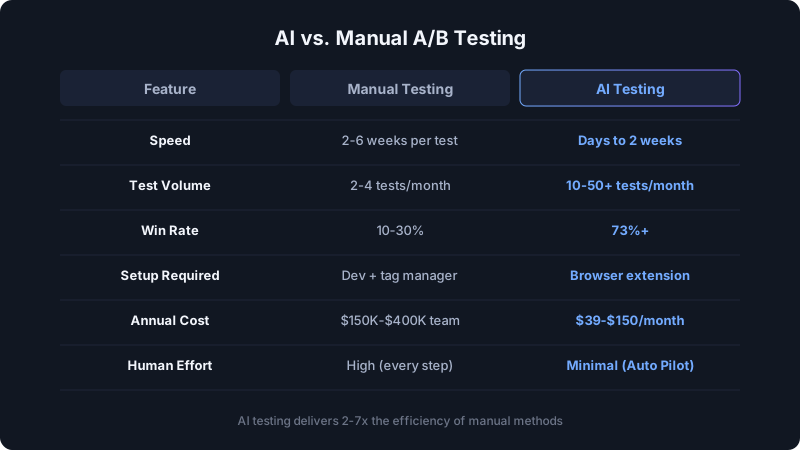
The differences are not incremental. They are structural. Here is how AI testing stacks up against the manual approach across every dimension that matters.
| Dimension | Manual A/B Testing | AI A/B Testing |
|---|---|---|
| Hypothesis generation | Human brainstorming (hours/days) | AI-generated in seconds |
| Variant creation | Requires designer + developer | AI generates automatically |
| Test velocity | 2-4 tests per month | 10-50+ tests per month |
| Statistical method | Usually fixed-horizon (prone to peeking) | SPRT or Bayesian (continuous monitoring) |
| Traffic allocation | Static 50/50 split | Dynamic, adaptive allocation |
| Learning across tests | Tribal knowledge, spreadsheets | ML model compounds learnings |
| Time to results | 2-6 weeks per test | Days to 2 weeks |
| Technical setup | Tag managers, dev support | Browser extension, no code |
| Cost of testing team | $150K-$400K/year (analyst + designer + dev) | $39-$150/month for software |
| Scalability | Linear (more tests = more people) | Exponential (AI handles volume) |
The data backs this up. Teams using AI-powered testing through Keak see an average 22.5% conversion rate increase within 2 weeks of starting. That timeline is often shorter than the duration of a single manual A/B test.
Types of AI Testing
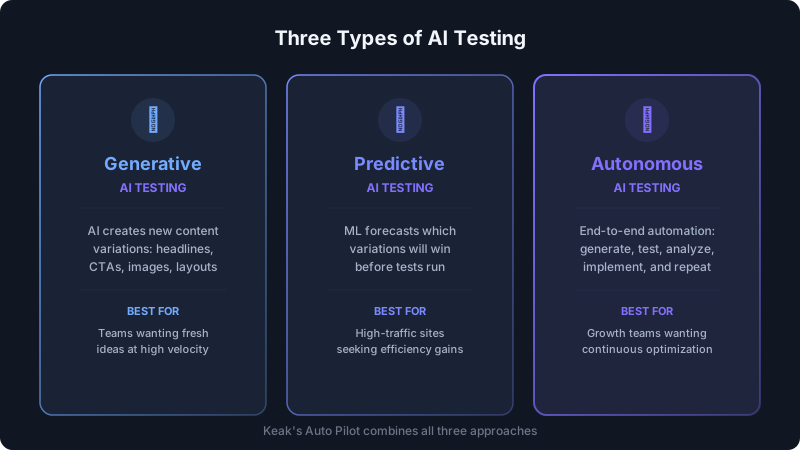
Not all AI testing is the same. Understanding the three main approaches helps you choose the right tool for your needs.
1. Generative AI Testing
This is the most common form today. The AI creates new content variations -- rewriting headlines, generating new CTA copy, suggesting image swaps, or rearranging page layouts. The generative model produces variants, and a separate statistical engine evaluates them.
Best for: Teams that want fresh ideas and high test velocity without a creative team dedicated to experimentation.
2. Predictive AI Testing
Predictive testing uses machine learning to forecast which variations are likely to win before the test runs. The model is trained on historical test data and page characteristics, and it assigns a probability of success to each potential variation. This lets you skip low-potential tests and focus traffic on high-potential ones.
Best for: High-traffic sites where even small efficiency gains in test selection save significant time and money.
3. Autonomous AI Testing
This is the most advanced form, and it combines both generative and predictive capabilities. The AI runs the entire optimization process without human intervention: generating hypotheses, creating variations, launching tests, analyzing results, implementing winners, and starting the next round.
Keak's Auto Pilot mode is an example of autonomous AI testing. You activate it, and the system continuously optimizes your site in the background. No manual input required at any stage.
Best for: Growth teams that want continuous optimization without dedicating headcount to experimentation programs.
Benefits of AI-Powered Testing (With Data)
Let's move past the theory and look at what the numbers actually show.
1. Dramatically Higher Test Velocity
The average optimization team runs 2-3 A/B tests per month (source: CXL Institute). AI testing platforms run 10-50+ tests in the same period. More tests mean more learning, more winners, and faster compounding of improvements.
2. Higher Win Rates
Most manual A/B tests have a win rate of 10-30% (source: Convert.com). That means 70-90% of the time you spend creating and running tests produces no improvement. Keak's AI achieves a 73%+ win rate because the model has learned what tends to work from thousands of prior experiments.
That is not a marginal improvement. That is 2-7x the efficiency of manual testing.
3. Faster Time to Impact
A typical manual test cycle is 4-6 weeks from idea to implemented winner. AI testing compresses this to days. The average Keak user sees measurable conversion rate improvement within 2 weeks of connecting their site. When you are paying for traffic through ads, every day of suboptimal conversion rates is money left on the table.
4. Elimination of Human Bias
Humans are notoriously bad at predicting what will convert. The HiPPO problem (Highest Paid Person's Opinion) kills more optimization programs than any technical limitation. AI does not care about opinions. It tests hypotheses objectively and follows the data.
5. Reduced Operational Cost
Building an in-house optimization team requires an analyst, a designer, a developer, and a strategist. That is $150,000-$400,000 per year in fully loaded costs. An AI testing tool costs a fraction of that. Keak's plans start at $39/month with a free tier available for sites under 5,000 monthly impressions.
6. Compounding Returns
Each AI-generated test makes the next one smarter. Over months, this compounding effect creates a widening gap between AI-optimized sites and manually optimized ones. The AI is not just running more tests -- it is running better tests over time as the model learns your specific audience.
How to Get Started with AI A/B Testing
Getting started is simpler than most teams expect. Here is the practical path.
Choose the Right Tool
The AI testing landscape includes several categories of tools. Legacy platforms like VWO and Optimizely have added AI features on top of their existing manual workflows. Google Optimize was sunset in 2023 and has not been replaced. Newer platforms like Keak were built AI-first, with automation as the core architecture rather than an add-on.
The key questions to ask when evaluating tools:
- Does the AI generate variations, or just analyze them? Some tools call themselves "AI-powered" but only use AI for traffic allocation or statistical analysis. True AI testing generates the variations too.
- How much setup is required? If you need a developer to install scripts and a designer to create variants, you are not getting the full benefit of AI.
- What statistical method does the platform use? Look for SPRT or Bayesian methods over fixed-horizon frequentist tests.
- Can it run autonomously? The biggest time savings come from tools that can operate without human intervention.
Start with High-Impact Pages
Focus your first AI tests on pages where improvements have the largest business impact: landing pages, pricing pages, signup flows, and checkout pages. These are the pages where a conversion rate increase translates directly to revenue.
Set It and Review Weekly
If your tool supports autonomous operation, use it. Set the AI to Auto Pilot and check in once a week to review results and learnings. Resist the urge to micromanage. The AI's 73%+ win rate is higher than what most human strategists achieve -- let it work.
Scale Across Your Site
Once you have validated the approach on your highest-value pages, expand testing to secondary pages: blog posts, category pages, product detail pages, and even your 404 page. Every page is an opportunity to improve the user experience and capture more conversions.
Common Misconceptions About AI A/B Testing
Skepticism is healthy. But some common objections are based on misunderstandings. Let's address them directly.
"AI testing is a black box -- I won't know why something won."
Modern AI testing tools show you exactly what changed and provide the statistical evidence for why it won. You can see the variation, the original, the sample size, the confidence level, and the lift. What the AI adds is the ability to generate and test ideas you would not have come up with yourself. The results are fully transparent.
"My site doesn't get enough traffic for A/B testing."
This used to be a valid concern with fixed-horizon statistics, where you needed thousands of visitors per variation. SPRT-based methods are more efficient with smaller sample sizes because they can reach valid conclusions as soon as sufficient evidence accumulates, rather than waiting for a predetermined sample size. If you get 10,000+ monthly visitors, you can run meaningful AI tests. Keak's free plan is designed for exactly this scenario.
"AI will make changes that hurt my brand."
You remain in control. Most AI testing platforms let you review and approve variations before they go live, or set guardrails around what the AI can and cannot change. The AI optimizes within constraints you define. And because every change is tested against your current page, a variation only wins if it actually performs better with your audience.
"We already have an optimization team -- we don't need AI."
AI does not replace your optimization team. It multiplies their output. Your strategists can focus on big-picture experimentation programs while the AI handles the high-volume execution of individual tests. Think of it as giving your team a tireless junior analyst who can generate and run 10x more tests.
"The results seem too good to be true."
A 22.5% average conversion lift sounds aggressive until you consider two factors. First, most websites have never been systematically optimized, so there is significant low-hanging fruit. Second, the AI's compounding learning effect means improvements accelerate over time. The first test might yield a 3% lift. The tenth test might yield 8%. Averaged across the full program, 22.5% is not just achievable -- it is the median outcome.
The Future of AI A/B Testing
The trajectory is clear. AI testing will become the default way websites are optimized, not the exception. Three trends are accelerating this shift.
Multimodal testing is expanding beyond text. AI systems are beginning to generate and test images, video thumbnails, and even page layouts -- not just headlines and button copy.
Predictive optimization will reduce the need for testing altogether in some cases. As AI models accumulate enough data, they will be able to predict optimal page configurations for specific audience segments without running a test first.
Personalization at scale will merge A/B testing with dynamic content delivery. Instead of finding the single best version of a page, AI will serve different optimized versions to different visitor segments in real time.
For a deeper look at how AI is reshaping the entire conversion optimization discipline, read our guide on how AI is changing CRO.
FAQ
Is AI A/B testing suitable for small businesses?
Yes. AI A/B testing is arguably more valuable for small businesses than for large enterprises. Small teams lack the headcount to run manual testing programs, but they still need to optimize their conversion rates. Tools like Keak offer free plans for sites with up to 5,000 monthly impressions, and paid plans start at $39/month -- far less than hiring a dedicated optimization specialist.
How long does it take to see results from AI A/B testing?
Most users see their first statistically significant test results within 1-2 weeks of starting. The timeline depends on your traffic volume and the magnitude of the improvement. Higher-traffic sites reach significance faster. Keak users report an average 22.5% conversion rate increase within 2 weeks, but the compounding effect means results continue to improve over months.
Does AI A/B testing work on any website platform?
Yes. Modern AI testing tools are platform-agnostic. Keak works on Shopify, Webflow, WordPress, Framer, Squarespace, and any other website. The browser extension approach means there is no platform-specific integration to worry about -- if your site runs in a browser, the tool can test it.
Will AI A/B testing slow down my website?
Not if the tool is well-built. Look for testing platforms with lightweight, asynchronous loading. Keak's pixel is approximately 34KB gzipped and loads within 10ms of your baseline page load time. By comparison, many traditional A/B testing tools add 100-300KB of blocking JavaScript. A slow testing tool creates a confounding variable that undermines your experiment results.
Can I use AI A/B testing alongside my existing analytics and testing tools?
Absolutely. AI testing tools are designed to complement your existing stack. You can run AI tests alongside Google Analytics, Hotjar, Mixpanel, or any other analytics platform. The AI testing tool handles experimentation; your analytics tools handle measurement and attribution. There is no conflict between them.
Ready to see what AI A/B testing can do for your site? Start testing for free with Keak -- no code changes, no tracking scripts, results in days.