

Statistical Significance in A/B Testing Explained (Simply)
Learn what statistical significance means in A/B testing, why it matters, and how to avoid common mistakes — explained without the jargon.

Statistical Significance in A/B Testing Explained (Simply)
Statistical significance in A/B testing tells you whether the difference you see between two variations is real or just random noise. It is the line between "this actually works" and "you got lucky with your sample." If you have ever ended a test early because one version was "clearly winning" after 200 visitors, this post is going to save you from expensive mistakes.
Statistical significance is a mathematical measure of confidence that the difference in performance between two test variations is caused by an actual difference — not by random chance. In A/B testing, it is typically expressed as a confidence level (usually 95%), meaning there is only a 5% probability that the observed result happened by coincidence alone.
Why Statistical Significance Matters in A/B Testing
Without statistical significance, you are guessing. You might as well flip a coin.
Here is the problem: every A/B test will show a difference between variations. Always. Even if you test the exact same page against itself, random fluctuations in visitor behavior will create a gap. Tuesday visitors behave differently than Thursday visitors. Morning traffic converts differently than evening traffic. These natural variations create the illusion of a winner when no real winner exists.
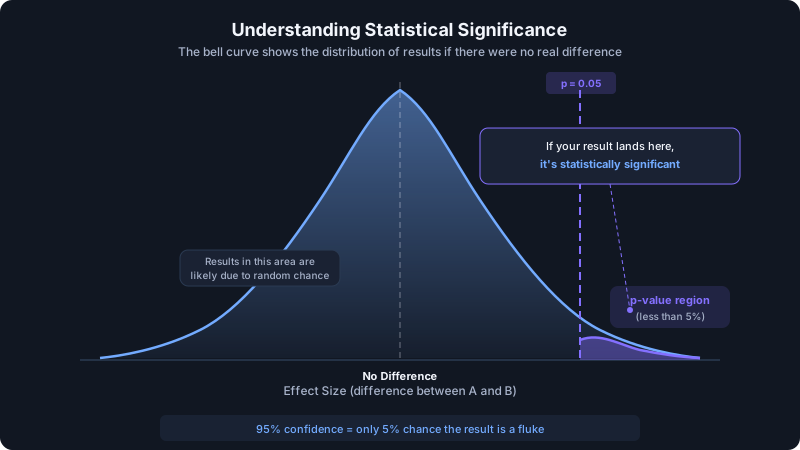
Statistical significance is the filter that separates real performance differences from noise. It answers one question: "If there were truly no difference between A and B, how likely would I be to see a result this extreme?"
According to a VWO analysis, roughly 80% of A/B tests that are ended prematurely produce results that do not hold up over time (VWO, 2024). That means teams are implementing "winning" changes that either do nothing or actively hurt conversion rates. Statistical significance prevents this.
Getting this right is especially important when the decisions carry real revenue impact. A false positive on a checkout page test could cost you thousands of dollars in lost conversions before you notice the mistake.
Key Concepts Explained Simply
You do not need a statistics degree to run valid A/B tests. You need to understand five concepts.
P-Value: The Probability You Got Fooled by Chance
The p-value is the probability that the difference you observed happened purely by random chance, assuming there is actually no difference between your variations.
A p-value of 0.05 means there is a 5% chance the result is a fluke. That is the standard threshold for most A/B tests. If your p-value drops below 0.05, you call the result "statistically significant."
Think of it this way: if you flipped a coin 10 times and got 7 heads, you would not conclude the coin is rigged. But if you flipped it 10,000 times and got 7,000 heads, something is clearly going on. The p-value quantifies that intuition.
Common misconception: A p-value of 0.05 does not mean there is a 95% chance your variation is better. It means that if the variations were identical, you would see a result this extreme only 5% of the time. The distinction matters, but for practical decision-making, the takeaway is the same: low p-value = higher confidence the difference is real.
Confidence Level: How Sure You Need to Be
The confidence level is simply 1 minus the p-value threshold, expressed as a percentage. If your threshold is p < 0.05, your confidence level is 95%.
| Confidence Level | P-Value Threshold | What It Means |
|---|---|---|
| 90% | 0.10 | 1 in 10 chance of false positive |
| 95% | 0.05 | 1 in 20 chance of false positive (standard) |
| 99% | 0.01 | 1 in 100 chance of false positive |
95% is the industry standard for most A/B tests. You can use 90% for lower-stakes tests (button color on a blog page) or 99% for higher-stakes decisions (pricing page redesign). The higher the confidence level, the more traffic you need to reach significance.
Statistical Power: Your Ability to Detect Real Differences
Statistical power is the probability that your test will detect a real difference when one actually exists. The standard target is 80%, meaning your test has an 80% chance of catching a true winner.
If your power is too low, you will run tests that end inconclusively — not because your variation did not work, but because your test was not sensitive enough to detect the improvement. Low power wastes time and traffic.
Power depends on three factors:
- Sample size (more visitors = more power)
- Effect size (bigger differences are easier to detect)
- Significance threshold (stricter thresholds reduce power)
Minimum Detectable Effect (MDE): The Smallest Change Worth Catching
MDE is the smallest improvement you care about detecting. If your baseline conversion rate is 3% and you set an MDE of 10% relative (meaning you want to detect a lift to 3.3% or higher), your test needs fewer visitors than if you set an MDE of 5% relative.
Practical guidance: For most tests, an MDE of 10-20% relative improvement is reasonable. If you are testing a radical redesign, you might expect a larger effect and can use a higher MDE (which means fewer visitors needed). For incremental copy changes, use a smaller MDE (which means more visitors needed).
The MDE is a trade-off lever. Smaller MDE = more precision but more traffic and time required.
Sample Size: How Many Visitors You Actually Need
This is where most teams get it wrong. You need far more visitors than you think.
A rough formula for sample size per variation:
n = 16 x (p x (1 - p)) / (MDE)^2
Where:
- p = baseline conversion rate (as a decimal)
- MDE = minimum detectable effect (as an absolute decimal)
Example: Your current conversion rate is 4% (p = 0.04), and you want to detect a 1 percentage point increase (MDE = 0.01).
n = 16 x (0.04 x 0.96) / (0.01)^2 n = 16 x 0.0384 / 0.0001 n = 6,144 visitors per variation
That is 12,288 total visitors for a standard A/B test with two variations. At 1,000 visitors per day, that is roughly 12 days of testing.
If your site gets 500 visitors per day, that same test takes about 25 days. This is why low-traffic sites need to focus on testing bigger changes (larger expected effect = lower required sample size) rather than micro-optimizations.
For a more detailed walkthrough of setting up tests properly, see our A/B testing guide.
Common Statistical Mistakes in A/B Testing
These errors are rampant. Avoiding them puts you ahead of most teams running tests.
1. Peeking at Results Too Early
This is the most common and most damaging mistake. Checking results before reaching your required sample size inflates your false positive rate dramatically.
Here is why: early in a test, random variation is enormous. If you check results after 500 visitors and see Variation B is "up 30%," it feels compelling. But that early lead is almost certainly noise. If you stop the test, you are locking in a random fluctuation as a permanent change.
Research from Optimizely showed that if you peek at results daily and stop when you see significance, your actual false positive rate can exceed 30% — even with a 95% confidence threshold (Optimizely, 2024). You set up for 5% error and end up with 30%+.
The fix: Decide your sample size before starting the test. Do not look at results until you hit that number. Or use a sequential testing method (more on that below).
2. Stopping Tests Too Soon
Related to peeking, but distinct. Some teams set a time-based rule ("we run tests for one week") instead of a sample-size-based rule. If your traffic is lower than expected that week, you end the test underpowered.
A test that does not reach adequate sample size tells you nothing. It is not a "no result." It is wasted effort.
Always base your stopping rule on statistical criteria, not calendar dates.
3. Running Too Many Variants
Testing five variations simultaneously sounds efficient. It is not. Each additional variation requires more traffic to maintain statistical power, and it increases your chance of a false positive through multiple comparisons.
With five variations (A vs B vs C vs D vs E), the probability of at least one false positive at a 95% confidence level rises to roughly 19% without correction. That is nearly 1 in 5 tests producing a fake winner.
Best practice: Test 2-3 variations maximum per test. If you want to explore many ideas, run sequential tests. Platforms like Keak handle this automatically — the AI agent tests variations sequentially, learning from each result before generating the next round. Across 1.37 million+ variations created, this approach delivers a 73%+ win rate because each test builds on validated learnings.
4. Ignoring Seasonality and External Factors
A test that runs from Monday to Friday captures different behavior than one running Saturday to Sunday. A test running during a holiday sale captures different behavior than one running during a normal week.
Always run tests for at least one full business cycle — typically 1-2 full weeks minimum — to capture day-of-week effects. If your business has strong seasonality (e-commerce around Black Friday, travel in summer), avoid drawing conclusions from tests run during atypical periods.
Also watch for external confounders: a competitor launching a major campaign, a news event driving unusual traffic, or an email blast sending a spike of high-intent visitors during your test. Any of these can distort results.
SPRT vs Fixed-Horizon Testing
Traditional A/B testing uses a fixed-horizon approach: calculate your sample size upfront, run the test until you hit that number, then analyze results. It is straightforward, but it has a significant downside — you cannot look at results along the way without inflating your false positive rate.
Sequential Probability Ratio Testing (SPRT) solves this problem. SPRT is a statistical method that lets you analyze results continuously as data comes in, without inflating error rates. It uses dynamic boundaries that adjust as more data accumulates.
Here is how it works: instead of a fixed sample size, SPRT defines two boundaries — one for "accept the variation" and one for "reject the variation." As data accumulates, a test statistic moves between these boundaries. When it crosses either boundary, the test concludes. If it has not crossed either boundary, you keep collecting data.
The advantage: SPRT typically reaches conclusions 20-50% faster than fixed-horizon tests when there is a clear winner, because it can stop as soon as the evidence is strong enough. When there is no real difference, it takes a similar amount of time.
This is the approach Keak uses. Our SPRT-based statistics engine evaluates results continuously, so tests conclude as soon as statistical significance is achieved — no arbitrary time limits, no risk of peeking bias. Combined with our V3 engine (a machine learning model trained on thousands of successful A/B tests), this means tests run exactly as long as they need to and not a day longer.
For teams running tests on landing page elements, SPRT is particularly valuable because landing pages often have clear winners. The faster you identify and implement them, the sooner you capture the conversion lift.
When to Trust Your Results: A Practical Decision Framework
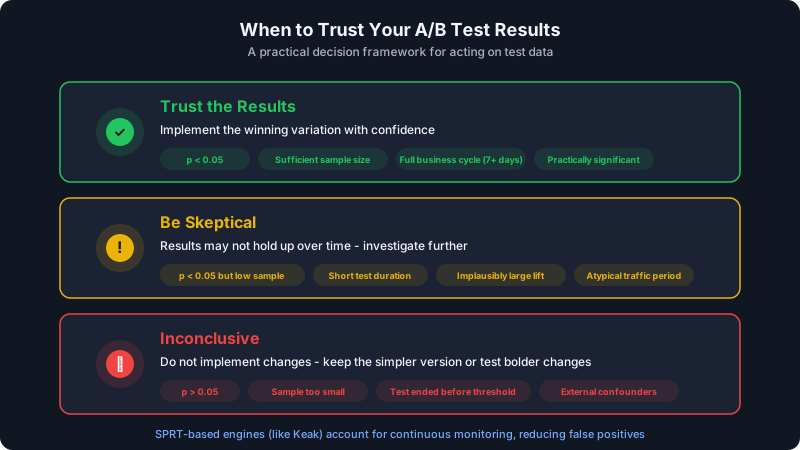
Statistics give you a probability, not a guarantee. Here is a practical framework for deciding when to act on test results.
Trust the result when:
- Confidence level is 95%+ (p-value < 0.05). This is your baseline. Do not implement changes below this threshold unless the stakes are very low.
- You reached your pre-calculated sample size. If you planned for 10,000 visitors per variation and hit that number, your test has adequate power.
- The test ran for at least 7 days. This captures day-of-week effects and reduces the chance of temporal bias.
- The result is practically significant. A statistically significant 0.1% lift is real but probably not worth implementing. Make sure the lift is large enough to matter to your business.
- The result aligns with directional logic. If you made the CTA more prominent and conversions went up, that makes sense. If you hid the CTA and conversions went up, investigate before implementing.
Be skeptical when:
- The result appeared very quickly. Fast results with small samples are more likely to be noise, even if a calculator shows significance. (SPRT-based tests are an exception here, as the method accounts for continuous monitoring.)
- The lift is implausibly large. A 200% conversion lift from changing a button color is almost certainly a data issue, not a real effect.
- Your traffic during the test was atypical. Holiday rushes, viral posts, or server outages can distort results.
- You ran many tests simultaneously on the same page. Overlapping tests can interact in unpredictable ways.
When results are inconclusive:
An inconclusive test is not a failure. It tells you the difference between your variations is smaller than your MDE — meaning neither version is meaningfully better. In this case:
- Keep the simpler version. If the original and variation perform similarly, keep the one that is easier to maintain.
- Test a bigger change. If subtle tweaks are not moving the needle, try bolder variations. Our guide on getting started with A/B testing covers how to prioritize high-impact test ideas.
- Segment the data. The overall result might be flat, but one device type or traffic source might show a strong effect worth pursuing.
The Bottom Line
Statistical significance is not optional in A/B testing. It is the difference between making data-driven decisions and making expensive guesses that feel data-driven.
You do not need to become a statistician. You need to understand three things: set your sample size before you start, do not peek, and wait for 95% confidence. If you can follow those three rules, you will make better decisions than the majority of teams running A/B tests today.
Or, let a system handle the statistics for you. Keak's Auto Pilot mode manages the entire testing lifecycle — generating variations, monitoring for significance using SPRT, implementing winners, and launching the next test — across 1.4 million+ weekly users without requiring you to touch a calculator or a statistics textbook. The pixel is roughly 34KB gzipped, loads asynchronously within 10ms of baseline, and requires zero code changes thanks to our Chrome extension.
The math is important. Getting it right is more important. Getting it right automatically is best.
FAQ
What confidence level should I use for A/B testing?
95% confidence (p-value < 0.05) is the standard for most A/B tests. This means there is only a 5% probability that your result is due to random chance. Use 90% for low-stakes tests where speed matters more than precision. Use 99% for critical decisions like pricing changes or major redesigns where a wrong call is expensive.
How many visitors do I need for a statistically significant A/B test?
It depends on your baseline conversion rate and the minimum effect you want to detect. As a rough guide: a site converting at 3% that wants to detect a 1-percentage-point improvement needs about 6,000-7,000 visitors per variation (12,000-14,000 total). Lower baseline rates and smaller expected effects require more visitors. Use a sample size calculator before starting any test.
Can I check my A/B test results before the test is finished?
With traditional fixed-horizon testing, no — peeking inflates your false positive rate from 5% to potentially 30%+. With sequential testing methods like SPRT, yes — the method is designed for continuous monitoring and adjusts significance thresholds accordingly. If your testing platform uses SPRT (as Keak does), checking results early is built into the methodology and will not compromise your conclusions.
How long should I run an A/B test?
Run your test until you reach both your required sample size and a minimum of 7 days (to capture day-of-week effects). For most sites, this means 2-4 weeks. Never set a fixed time limit without also setting a sample size requirement. A one-week test on a low-traffic site is almost never sufficient for reliable results.
What is the difference between statistical significance and practical significance?
Statistical significance tells you a difference is real (not due to chance). Practical significance tells you a difference is meaningful (worth acting on). A test might show a statistically significant 0.05% lift in conversion rate — the difference is real, but implementing and maintaining a new variation for a 0.05% gain is rarely worth the effort. Always evaluate both: is the result real, and is it big enough to matter?