

What Is a Good Conversion Rate? Benchmarks by Industry (2026)
See average conversion rate by industry for 2026. Compare your site against benchmarks for e-commerce, SaaS, B2B, finance, and more — plus how to improve.

What Is a Good Conversion Rate? Benchmarks by Industry (2026)
The average conversion rate by industry ranges from 1.8% to 11%, but the number that matters is whether your rate is climbing or stalling. If you have been Googling "what is a good conversion rate" hoping for a single magic number, you are going to be disappointed — and then relieved, because context tells you far more than a flat average ever could.
Conversion rate is the percentage of visitors who complete a desired action — a purchase, a signup, a form submission — divided by total visitors, expressed as a percentage. It is the single most direct measure of whether your website is doing its job. A "good" rate depends entirely on your industry, traffic source, and what you are asking visitors to do.
What Is a Good Conversion Rate?
The short answer: 2-5% is the typical range across most industries. If you are above 5%, you are outperforming the majority of websites. If you are above 10%, you are in the top tier.
But averages flatten reality. A 2% conversion rate might be stellar for a luxury real estate site and abysmal for a free-trial SaaS page. The only honest answer is: a good conversion rate is one that is better than your own last month and trending upward.
According to WordStream's analysis of thousands of landing pages, the median conversion rate sits around 2.35%, while the top 25% of sites convert at 5.31% or higher. The top 10% reach 11.45%+ (WordStream, 2024). These numbers have held remarkably steady over the past several years, even as traffic patterns have shifted.
Conversion Rate Benchmarks by Industry (2026)
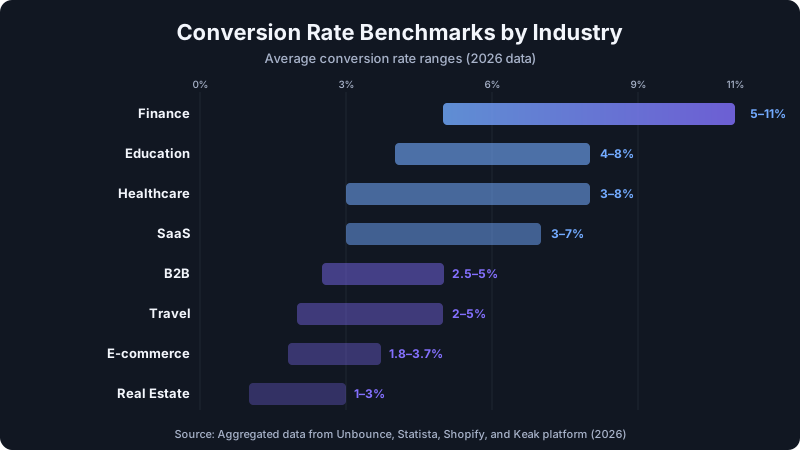
Here is the data you came for. These ranges reflect aggregated averages from Unbounce, Statista, Shopify, and internal Keak platform data across 2.1 billion+ impressions tested.
| Industry | Average Conversion Rate | Top Performers |
|---|---|---|
| E-commerce | 1.8 - 3.7% | 5%+ |
| SaaS | 3 - 7% | 10%+ |
| B2B Services | 2.5 - 5% | 7%+ |
| Finance & Insurance | 5 - 11% | 15%+ |
| Healthcare | 3 - 8% | 10%+ |
| Education | 4 - 8% | 12%+ |
| Real Estate | 1 - 3% | 4%+ |
| Travel & Hospitality | 2 - 5% | 7%+ |
E-commerce: 1.8 - 3.7%
E-commerce sits at the lower end because purchase intent varies wildly. A visitor browsing a product catalog is fundamentally different from someone who clicked a retargeting ad with a 20%-off coupon. Shopify's own data puts the average Shopify store at roughly 1.4%, with top performers hitting 3.3%+ (Shopify, 2024).
The gap between average and top performers is the opportunity. Even moving from 1.8% to 2.5% on a store doing $500K in annual revenue translates to roughly $194,000 in additional sales — without spending a dollar more on traffic.
SaaS: 3 - 7%
SaaS conversion rates skew higher because the "conversion" is often a free trial or demo request rather than a direct purchase. The friction is lower. Unbounce's conversion benchmark report shows SaaS landing pages averaging around 3-5% for paid traffic and 5-7% for organic (Unbounce, 2024).
Free-trial pages convert at significantly higher rates than direct-purchase pages. If your SaaS conversion rate is below 3%, your landing page messaging or form length likely needs work.
B2B Services: 2.5 - 5%
B2B has longer sales cycles and multiple decision-makers. A "conversion" here is typically a lead form submission, consultation request, or content download. According to HubSpot, the average B2B landing page converts at 2.5-3.5%, with well-optimized pages reaching 5%+ (HubSpot, 2024).
Finance & Insurance: 5 - 11%
Finance consistently leads benchmark tables. Why? High intent and high urgency. People searching for insurance quotes or loan rates are ready to act. WordStream data places financial services landing pages at a median of 5.01%, with top quartile pages exceeding 11% (WordStream, 2024).
Healthcare: 3 - 8%
Healthcare conversions — appointment bookings, consultation requests, patient portal signups — benefit from strong intent. Patients searching for providers are motivated. The range varies significantly between general health content sites (lower end) and specialty practice sites (higher end).
Education: 4 - 8%
Education, particularly online course platforms and higher-ed enrollment pages, converts well. The "conversion" is often an inquiry form or application start, which carries lower commitment than a purchase. Unbounce reports education landing pages averaging around 5.8% (Unbounce, 2024).
Real Estate: 1 - 3%
Real estate has the lowest benchmarks for a reason: the transaction is enormous and the decision cycle is long. A "conversion" here is a property inquiry or agent contact form. Getting above 2% consistently in real estate puts you ahead of most competitors.
Travel & Hospitality: 2 - 5%
Travel conversions are seasonal and price-sensitive. Booking engines with strong UX and urgency messaging (limited availability, price alerts) tend to cluster at the higher end of this range.
Conversion Rate by Traffic Source
Where your visitors come from changes everything. The same landing page will convert at vastly different rates depending on the traffic source.
| Traffic Source | Average Conversion Rate |
|---|---|
| 4 - 8% | |
| Organic Search | 2 - 5% |
| Direct | 2 - 4% |
| Paid Search (PPC) | 2 - 5% |
| Social Media | 0.5 - 3% |
| Referral | 1 - 4% |
Email consistently outperforms every other channel because it reaches people who already know you. They opted in. They are warm. According to Barilliance, email-driven traffic converts at roughly 4.29% on average — more than double the rate of social media traffic (Barilliance, 2024).
Organic search converts well because it captures intent. Someone who typed "best project management software for small teams" is further along the buying journey than someone who saw your Instagram ad.
Social media sits at the bottom because most social traffic is casual. Users were scrolling, saw something interesting, and clicked. They were not actively searching for a solution. This does not mean social is worthless — it means your expectations and optimization strategy should differ by channel.
Conversion Rate by Device
Device-level benchmarks reveal a persistent gap that most teams underestimate.

| Device | Average E-commerce Conversion Rate |
|---|---|
| Desktop | 3.0 - 4.5% |
| Tablet | 2.5 - 3.5% |
| Mobile | 1.5 - 2.5% |
Desktop still converts at roughly 1.5-2x the rate of mobile across most industries. Statista data from 2024 puts the global mobile e-commerce conversion rate at 2.2% compared to 3.7% on desktop (Statista, 2024).
Yet mobile accounts for over 60% of all web traffic in most verticals. This means the majority of your visitors are experiencing the version of your site that converts worst. Optimizing mobile experience is the single highest-leverage move for most websites.
This is where automated testing becomes valuable. Keak's AI agent can generate and test mobile-specific variations of your headlines, CTAs, and layouts — running tests across device segments simultaneously without requiring you to build separate mobile landing pages. Across our platform, sites that actively test mobile variations see a 22.5% average conversion rate increase within the first two weeks.
Why Benchmarks Matter (and Why They Can Mislead)
Benchmarks are useful as a sanity check, not a ceiling. They help you answer: "Am I in the ballpark?" They do not answer: "Am I optimized?"
Here is why benchmarks can mislead:
They flatten massive variation. A "3% average" for e-commerce blends together a niche artisan shop selling $2,000 handmade furniture with a fast-fashion retailer selling $15 t-shirts. Their conversion rates should be different. Comparing them is meaningless.
They ignore your specific funnel. Your conversion rate depends on what you are counting as a conversion, how much traffic you get, where that traffic comes from, and what you are selling. Benchmarks cannot account for any of that.
They create false comfort. If the industry average is 2.5% and you are at 3%, you might stop optimizing. But your top competitor might be at 6%. The benchmark told you nothing about the competitive landscape.
The better approach: Use benchmarks to identify whether you have a serious problem (converting at 0.5% in a 3-5% industry signals something is broken). Then forget the benchmarks and focus on your own rate over time. The goal is continuous improvement, not hitting an arbitrary average.
How to Improve Your Conversion Rate If You Are Below Benchmark
If your numbers are below the ranges listed above, here is a practical roadmap.
1. Fix Your Page Speed
Google's data shows that as page load time increases from 1 to 3 seconds, bounce probability increases by 32%. From 1 to 5 seconds, it jumps to 90% (Google, 2024). Speed is table stakes.
Run your pages through Google PageSpeed Insights. Target a Largest Contentful Paint (LCP) under 2.5 seconds on mobile.
2. Clarify Your Value Proposition
Most underperforming pages suffer from unclear messaging, not bad design. Your visitor should understand what you offer, who it is for, and why they should act now within 5 seconds of landing.
Test different headline variations. This is the single most impactful element to A/B test on any landing page.
3. Reduce Form Friction
Every additional form field costs you conversions. The Baymard Institute found that 18% of users abandon checkout because the process was "too long or complicated" (Baymard Institute, 2024). Ask only for what you absolutely need at the conversion point.
4. Add Social Proof Strategically
Place testimonials, reviews, client logos, and case study snippets near your CTA. According to Spiegel Research Center, displaying reviews can increase conversion rates by up to 270% for higher-priced products.
5. Test Continuously (Not Once)
A single test tells you one thing. Continuous testing compounds. Each winning variation becomes the new baseline, and the next test builds on top of it.
This is the philosophy behind Keak's Auto Pilot mode. The AI agent generates variations, launches tests, waits for statistical significance using our SPRT-based statistics engine, implements winners, and repeats — automatically. Across 1.37 million+ variations created, our users see a 73%+ test win rate because the AI learns from every previous result.
6. Segment and Personalize
Stop treating all visitors the same. A first-time visitor from a Google ad needs a different experience than a returning customer from an email campaign. Even basic segmentation by traffic source and device can unlock significant gains.
7. Optimize for Mobile First
Given the device conversion gap, prioritize your mobile experience. Test mobile-specific CTAs, simplify navigation, and ensure your checkout flow works flawlessly on a phone. If you sell on Shopify, our guide on how to A/B test your Shopify store covers mobile-specific strategies.
What the Top 10% Do Differently
The highest-converting sites in every industry share a few common traits:
- They test relentlessly. Not once a quarter — continuously. Every page, every element, every audience segment.
- They prioritize speed. Sub-2-second load times are non-negotiable.
- They write for one audience at a time. Specificity converts. Generality does not.
- They reduce cognitive load. Fewer choices, clearer hierarchy, more whitespace.
- They use data, not opinions. They do not argue about button colors in meetings. They test and let the data decide.
FAQ
What is the average conversion rate across all industries?
The average conversion rate across all industries is roughly 2-5%, with a median around 2.35% according to WordStream data. However, this number varies significantly by industry — finance and insurance can average 5-11%, while real estate typically falls between 1-3%. Your specific rate depends on your industry, traffic source, product, and what you define as a conversion.
Is a 1% conversion rate bad?
Not necessarily. A 1% conversion rate is below average for most industries, but context matters. High-ticket items like luxury goods, real estate, and enterprise software naturally have lower conversion rates because the purchase decision is bigger. If you are selling a $50,000 product, a 1% conversion rate might generate excellent revenue. If you are selling a $20 t-shirt, 1% signals a problem worth investigating.
How do I calculate my conversion rate?
Divide the number of conversions by the total number of visitors, then multiply by 100. For example: 50 purchases from 2,000 visitors = (50 / 2,000) x 100 = 2.5% conversion rate. Make sure you are consistent about what counts as a "conversion" and what counts as a "visitor" (sessions vs unique users).
Why is my mobile conversion rate so much lower than desktop?
Mobile conversion rates are typically 1.5-2x lower than desktop because of smaller screens, harder-to-use forms, slower connections, and more distractions. Users also tend to browse on mobile but purchase on desktop. To close the gap, simplify your mobile checkout, use autofill-friendly forms, reduce page weight, and test mobile-specific layouts and CTAs.
How often should I update my conversion rate benchmarks?
Review your benchmarks quarterly and compare against fresh industry data annually. Benchmarks shift as consumer behavior, technology, and competition evolve. More importantly, track your own month-over-month conversion rate trend. A rising trend matters more than any external benchmark. Tools that automate continuous testing help you stay ahead of shifts without manual effort.