

Keak vs Optimizely: Which A/B Testing Tool Is Right for You?
Keak vs Optimizely compared across pricing, AI capabilities, ease of setup, and features. Find the right A/B testing tool for your team and budget.

Keak vs Optimizely: Which A/B Testing Tool Is Right for You?
Choosing between Keak vs Optimizely comes down to one question: do you want an AI agent that runs your entire A/B testing program automatically, or do you need a full enterprise experimentation suite with feature flags and content management? Both platforms deliver results, but they serve fundamentally different needs at wildly different price points.
The short version: Keak is an autonomous AI testing platform that generates variations, launches tests, and optimizes your site without manual work — starting free. Optimizely is an enterprise experimentation and content platform built for large organizations with dedicated optimization teams and six-figure budgets.
Keak vs Optimizely at a Glance
Before diving into the details, here is how the two platforms stack up across the categories that matter most.
| Feature | Keak | Optimizely |
|---|---|---|
| Starting price | Free (10K impressions) | ~$36K/year (custom quote) |
| Setup time | 2 minutes (Chrome extension) | Weeks to months (developer required) |
| AI-generated variations | Yes — autonomous | No — manual creation |
| Auto Pilot mode | Yes | No |
| Code changes required | No | Yes (snippet installation) |
| Best for | SMBs, e-commerce, marketing teams | Large enterprises, product teams |
| Test win rate | 73%+ | Not publicly reported |
| Feature flags | No | Yes |
| Server-side testing | No | Yes |
| CMS included | No | Yes (separate product) |
This table tells an important story. Keak and Optimizely are not direct competitors — they occupy different segments of the market. But if your primary goal is increasing website conversions through A/B testing, the comparison is worth making.
Company Overviews
Keak
Keak is an AI-powered A/B testing platform built to eliminate the manual work that makes traditional optimization programs fail. Instead of requiring you to hypothesize, design, build, and analyze tests yourself, Keak's AI agent handles the entire process autonomously.
The platform's V3 engine is a machine learning model trained on thousands of successful A/B tests. It generates website variations — headlines, CTAs, images, layouts — launches tests automatically, waits for statistical significance using an SPRT-based statistics engine, learns from results, and repeats. The numbers back up the approach: 22.5% average conversion rate increase in two weeks, a 73%+ test win rate, and over 2.1 billion impressions tested across 1.4 million weekly users.
Keak works through a lightweight Chrome extension or a developer-first Code SDK, supporting Shopify, Webflow, WordPress, Framer, Squarespace, and any other website — no tracking scripts or code changes needed.
Optimizely
Optimizely (formerly Optimizely Web, and before that, built from the Episerver acquisition) is an enterprise-grade experimentation, content management, and commerce platform. It is one of the most established names in the A/B testing space, with deep roots in web experimentation that go back over a decade.
The platform offers full-stack feature flagging, web experimentation, a visual editor, advanced targeting and segmentation, and integrations with major analytics platforms. Optimizely has expanded well beyond testing into content management (CMS) and digital commerce, positioning itself as an all-in-one digital experience platform.
Its strength lies in serving large organizations with dedicated optimization teams, complex testing requirements, and the budget to match.
Head-to-Head Comparison
Ease of Setup
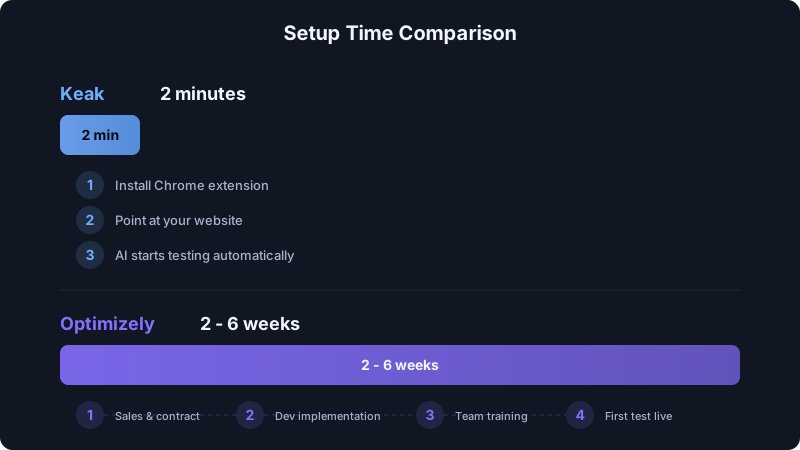
Keak wins — and it is not close.
Keak installs in under two minutes. You add the Chrome extension, point it at your website, and the AI starts generating and testing variations. There are no tracking scripts to install, no code changes to make, no developers to involve. The pixel is roughly 34KB gzipped, loads asynchronously, and adds less than 10ms to your page load time.
Optimizely requires a different level of commitment. You need to install a JavaScript snippet on your site, which typically means involving your development team. For server-side testing or feature flags, the setup becomes more involved with SDK integration. Most organizations report weeks to months from contract signing to running their first test, factoring in implementation, team training, and the learning curve of the platform.
If you are a marketing manager who wants to start testing today, Keak lets you do exactly that. Optimizely requires planning, resources, and patience.
AI Capabilities
Keak is built around AI. Optimizely uses it as a supplement.
This is the most significant differentiator between the two platforms. Keak's entire value proposition is its autonomous AI agent. Here is what that means in practice:
- The AI generates test variations for you. It creates alternative headlines, CTAs, images, and layouts based on what it has learned works across thousands of tests.
- It launches tests without your input. In Auto Pilot mode, the system runs continuously — testing, learning, and optimizing.
- It uses SPRT-based statistics to determine winners efficiently, without waiting for arbitrary time periods.
- It learns and iterates. When a test completes, the AI uses results to inform the next round of variations, getting smarter over time.
Keak has created over 1.37 million variations through this automated process — a volume that would be impossible with manual test creation.
Optimizely offers some machine learning capabilities, primarily around targeting and personalization. Its Stats Engine provides statistical rigor for test analysis. But test creation itself remains manual. You or your team must come up with hypotheses, design variations, and build them using the visual or code editor. The platform does not generate test ideas or create variations for you.
For teams that run a high volume of tests or lack dedicated optimization resources, Keak's autonomous approach delivers results that manual processes simply cannot match. For teams that want granular control over every test hypothesis and variation, Optimizely gives you that control.
Pricing
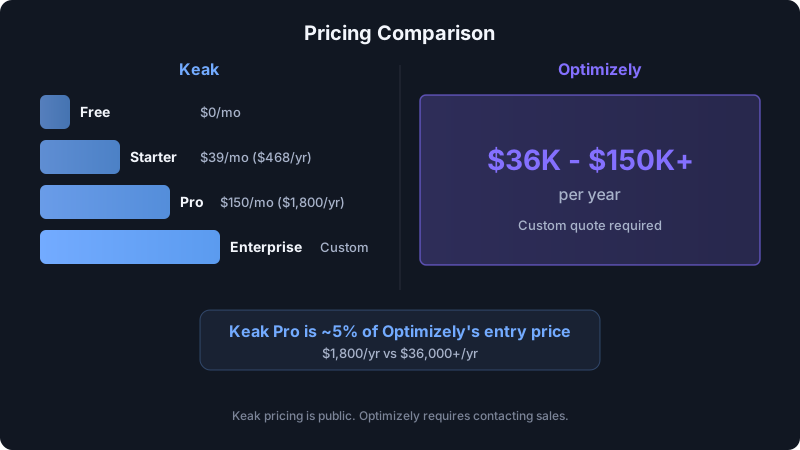
Keak is dramatically more affordable at every tier.
| Plan | Keak | Optimizely |
|---|---|---|
| Entry level | Free — 10K impressions, unlimited tests | Custom quote, typically $36K+/year |
| Growth | $39/mo (Starter, 25K impressions) | Custom, varies |
| Professional | $150/mo (Pro, 50K impressions) | $50K-$100K+/year |
| Enterprise | Custom pricing | $100K-$150K+/year |
Let that sink in. Keak's annual cost at the Pro tier ($1,800/year) is roughly 5% of Optimizely's entry-level pricing. And Keak's free plan includes unlimited tests — you pay based on impressions, not features.
Optimizely does not publish pricing on its website. You need to contact sales for a custom quote, and contracts are typically annual. The total cost often increases when you factor in implementation services, training, and the developer resources needed to maintain the platform.
For small and mid-sized businesses, Optimizely's pricing is often a non-starter. Even for larger companies, the ROI calculation must account for significant upfront and ongoing costs.
If cost efficiency matters to your organization — and it should — Keak delivers more automated value per dollar than any enterprise testing platform, including Optimizely. For more on affordable options, see our guide to the best A/B testing tools for small business.
Testing Features
Both platforms offer robust testing capabilities, but they approach them differently.
Keak's testing features:
- AI-generated A/B test variations (headlines, CTAs, images, layouts)
- Auto Pilot mode for fully automated, continuous testing
- SPRT-based statistics engine for faster, more efficient results
- V3 ML engine trained on thousands of successful tests
- Chrome extension for no-code test management
- Code SDK for developer-first implementation
- Multi-page and multi-element testing
Optimizely's testing features:
- Visual editor for creating test variations
- Code editor for advanced customization
- Full-stack feature flagging
- Server-side experimentation
- Multi-armed bandit testing
- Multivariate testing (MVT)
- Advanced audience targeting and segmentation
- Exclusion groups and mutual exclusivity
Optimizely's feature set is broader when it comes to experimentation types and targeting granularity. If you need server-side testing, feature flags, or complex audience segmentation, Optimizely offers capabilities that Keak does not.
But breadth is not the same as impact. Keak's AI-driven approach consistently delivers a 73%+ win rate — meaning nearly three out of four tests produce a measurable improvement. Most manual testing programs achieve win rates closer to 20-30%. More features do not matter if your tests are not winning.
Analytics and Reporting
Both platforms handle reporting well, with different philosophies.
Keak provides clear, actionable reporting focused on what matters: which variations won, by how much, and what to test next. The SPRT-based statistics engine reaches conclusions faster than traditional fixed-horizon testing, so you get results without waiting weeks for arbitrary sample sizes. Results feed directly back into the AI engine, informing future test generation.
Optimizely offers a robust Stats Engine with detailed statistical analysis, confidence intervals, and segmented results. You can slice data by audience segment, track multiple metrics per test, and integrate results with external analytics platforms like Google Analytics, Amplitude, and Mixpanel. For teams that want deep statistical analysis and custom reporting, Optimizely's analytics capabilities are excellent.
The difference: Keak turns reporting into action automatically. Optimizely gives you the data to make decisions manually.
Integrations
Optimizely has a broader integration ecosystem. Keak integrates where it matters most.
Optimizely connects with a wide range of analytics, data, and marketing platforms — Google Analytics, Segment, Amplitude, Salesforce, and dozens more. For enterprise organizations with complex tech stacks, this integration depth is valuable.
Keak takes a different approach. It works natively with the platforms most businesses actually use: Shopify, Webflow, WordPress, Framer, Squarespace, and any website with a browser. The Chrome extension model means there is nothing to integrate in the traditional sense — it works on top of your existing site without modifying your tech stack.
For most small and mid-sized businesses, Keak's platform compatibility covers everything they need. For enterprises with complex data pipelines and multi-tool analytics stacks, Optimizely's integration depth provides more flexibility.
Support and Documentation
Both platforms invest in customer success, scaled to their market.
Keak offers responsive support and documentation geared toward getting users to results fast. Because the platform is designed to work autonomously, the support burden is lighter — you do not need extensive training to let the AI run your tests.
Optimizely provides enterprise-grade support including dedicated customer success managers, professional services, and extensive documentation. They also offer Optimizely Academy for training and certification. For large teams that need hands-on implementation help, Optimizely's support infrastructure is mature and comprehensive.
The trade-off: Optimizely's support is necessary because the platform is complex. Keak's support is lighter because the platform is simple.
Scalability
Both platforms scale, but in different directions.
Keak scales from solo founders to growing businesses. The free plan supports experimentation from day one, and pricing grows with your traffic. The autonomous AI means scaling your testing program does not require scaling your team — the system generates more variations and runs more tests as your needs grow.
Optimizely scales for enterprise complexity. It handles millions of visitors, hundreds of concurrent experiments, feature flags across product teams, and server-side testing for applications. For organizations with 50+ person optimization teams and global testing programs, Optimizely's infrastructure is built for that scale.
If your definition of scale is "more tests, more results, less work," Keak wins. If it is "more teams, more use cases, more control," Optimizely wins.
Detailed Feature Comparison
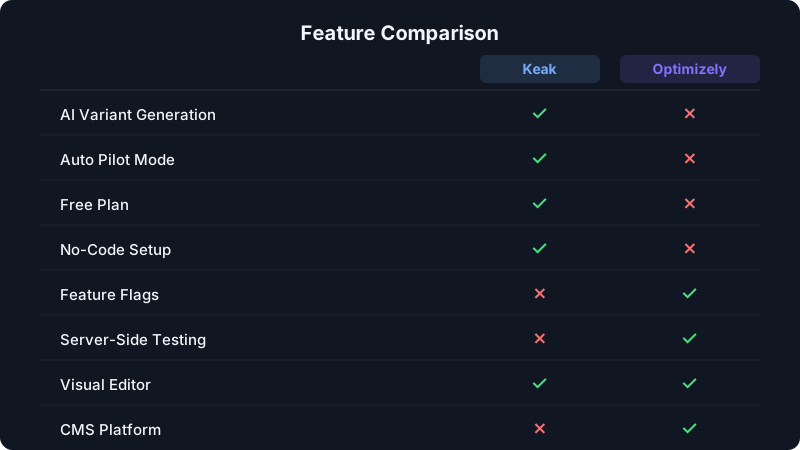
| Feature | Keak | Optimizely |
|---|---|---|
| AI variation generation | Yes — fully autonomous | No |
| Auto Pilot testing | Yes | No |
| Visual editor | Via Chrome extension | Yes — built-in |
| Code editor | Yes (Code SDK) | Yes |
| Free plan | Yes (10K impressions) | No |
| Starting price | $39/mo | ~$36K/year |
| Setup time | 2 minutes | Weeks to months |
| Code changes required | No | Yes |
| Feature flags | No | Yes |
| Server-side testing | No | Yes |
| SPRT statistics | Yes | No (sequential testing available) |
| CMS | No | Yes (separate product) |
| Commerce platform | No | Yes (separate product) |
| Multivariate testing | AI-driven multi-element | Yes — traditional MVT |
| Advanced targeting | AI-determined | Yes — rule-based |
| Page load impact | ~34KB, <10ms | Varies, typically heavier |
| Shopify support | Native | Via snippet |
| WordPress support | Native | Via snippet |
| Webflow support | Native | Limited |
| Framer support | Native | Limited |
| Squarespace support | Native | Limited |
| Average conversion lift | 22.5% in 2 weeks | Varies by implementation |
| Test win rate | 73%+ | Not publicly reported |
Who Should Choose Keak?
Keak is the right choice if you:
- Want results without manual work. The AI agent generates, tests, and optimizes variations autonomously. You set it up and let it run.
- Are a small or mid-sized business. Pricing starts free and scales affordably. You do not need a six-figure budget to start optimizing.
- Run an e-commerce store. Keak's native support for Shopify, Webflow, and other platforms means you can start improving product pages, landing pages, and checkout flows in minutes.
- Do not have a dedicated optimization team. Keak replaces the need for CRO specialists, designers, and developers in the testing process.
- Want fast time to value. Two-minute setup, first results in days, 22.5% average conversion lift in two weeks.
- Prefer no-code solutions. The Chrome extension means zero technical implementation. No scripts, no tags, no developers.
If you are coming from Google Optimize and looking for a modern replacement, Keak is purpose-built for that transition. See our best Google Optimize alternatives guide for a full breakdown.
Who Should Choose Optimizely?
Optimizely is the right choice if you:
- Are a large enterprise with a dedicated optimization team. The platform rewards investment — both financial and in human resources.
- Need feature flags and server-side testing. If your testing extends beyond website UI into product features and backend systems, Optimizely's full-stack capabilities are genuinely strong.
- Require advanced audience targeting. Complex segmentation rules, exclusion groups, and personalization at scale are Optimizely strengths.
- Want an all-in-one digital experience platform. Optimizely's CMS and commerce products create a unified ecosystem for content, commerce, and experimentation.
- Have the budget. At $36K-$150K+ per year, Optimizely is an investment. If your organization generates enough revenue that a 1-2% conversion improvement justifies that spend, it can deliver returns.
- Need extensive integrations. Complex analytics stacks with Segment, Amplitude, and custom data pipelines benefit from Optimizely's integration depth.
Optimizely is a powerful platform. The question is whether you need — and can afford — that power.
The Verdict
For most businesses, Keak is the better choice. Here is why:
The majority of companies evaluating A/B testing tools want the same thing: more conversions, less effort, reasonable cost. Keak delivers all three. Its autonomous AI eliminates the biggest bottleneck in optimization — the manual work of creating and managing tests. At a fraction of Optimizely's cost, Keak produces a 22.5% average conversion increase in just two weeks.
Optimizely remains the stronger option for large enterprises that need feature flags, server-side testing, or a combined experimentation-CMS-commerce platform. If your organization has a dedicated experimentation team with the budget and expertise to maximize a complex platform, Optimizely can deliver significant value.
But if you are honest about where most optimization programs fail — not enough tests, not enough variations, not enough velocity — Keak's AI-first approach solves the root problem. You do not need more features. You need more tests that win. And with a 73%+ win rate across 1.37 million generated variations, Keak delivers exactly that.
To learn more about how AI is transforming the optimization landscape, read our complete guide to AI-powered A/B testing.
Frequently Asked Questions
Is Keak a direct replacement for Optimizely?
It depends on what you use Optimizely for. If your primary use case is website A/B testing to improve conversions, Keak replaces Optimizely and adds autonomous AI capabilities at a fraction of the cost. If you rely on Optimizely for feature flags, server-side experimentation, or its CMS and commerce platforms, those are separate products that Keak does not replicate. For pure website optimization, Keak is not just a replacement — it is an upgrade.
How does Keak's AI compare to Optimizely's machine learning?
Keak's AI is fundamentally different. It is an autonomous agent that generates test variations, launches experiments, analyzes results, and iterates — all without human intervention. The V3 engine is trained on thousands of successful A/B tests and achieves a 73%+ win rate. Optimizely uses machine learning primarily for personalization and targeting, but test creation and management remain manual processes. Keak automates the entire testing lifecycle; Optimizely automates parts of it.
Can Keak handle high-traffic websites?
Yes. Keak has tested over 2.1 billion impressions and serves 1.4 million weekly users. The pixel is approximately 34KB gzipped and loads asynchronously within 10ms of baseline, so performance impact is negligible even at scale. Pricing tiers accommodate growing traffic, and enterprise plans offer custom impression limits for high-volume sites.
Why is Optimizely so much more expensive than Keak?
Optimizely is priced as an enterprise platform because it includes capabilities beyond A/B testing — feature flags, a CMS, commerce tools, and professional services. You are paying for a broader product suite and enterprise-grade support. Keak focuses specifically on AI-powered conversion optimization, which allows it to deliver better testing results at a dramatically lower price point. For businesses that need only A/B testing and conversion optimization, Optimizely's pricing includes a significant premium for features they will never use.
Can I switch from Optimizely to Keak?
Yes, and the transition is straightforward. Because Keak requires no code changes or script installation — just a Chrome extension — you can start running Keak tests alongside or instead of Optimizely immediately. There is no migration process, no data to transfer, and no implementation timeline. Install the extension, activate Auto Pilot, and Keak's AI begins generating and testing variations within minutes. Many teams run Keak in parallel with their existing tools during evaluation before fully transitioning.